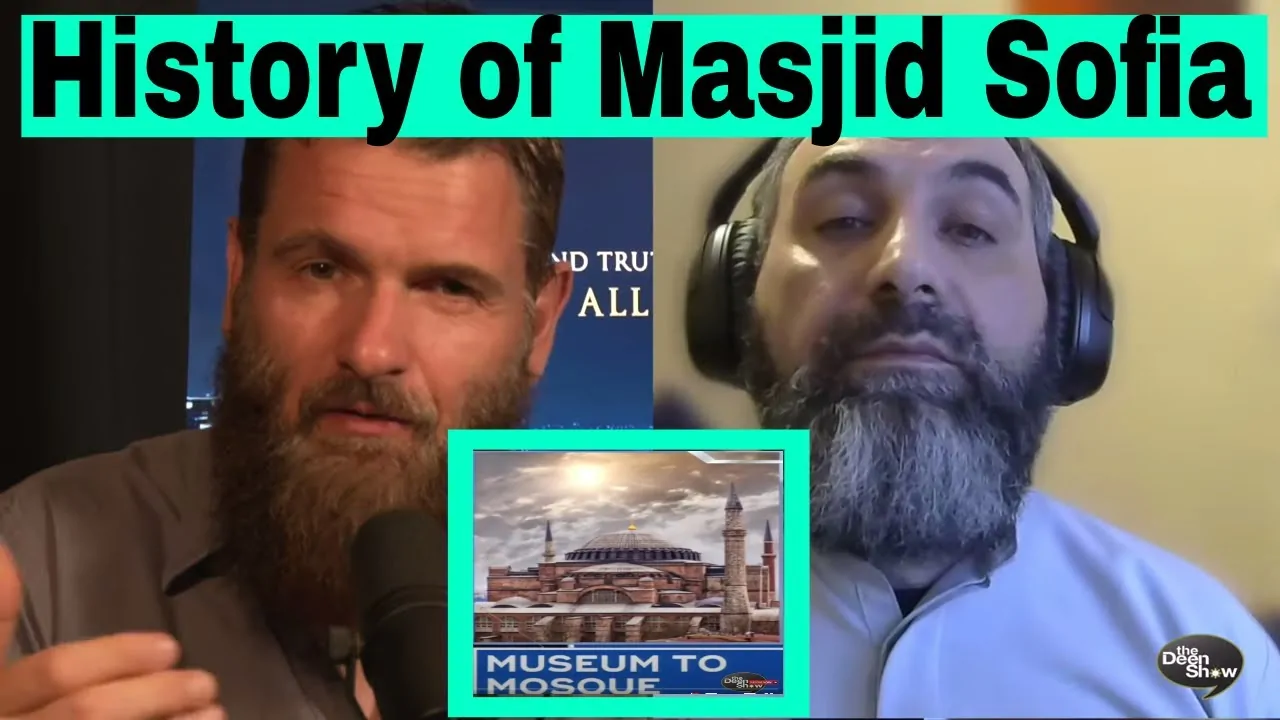
The building known today as Masjid Sofia has passed through more hands — and more contradictions — than almost any other structure on earth. Originally built as the crown jewel of Eastern Christendom in 6th-century Constantinople, it was later desecrated by fellow Christians, occupied as a house of immorality by Crusaders, restored to magnificence under the Ottoman Muslims, stripped of its spiritual identity by secularism, and now stands as a functioning masjid once more. Understanding the current controversy requires cutting through over a millennium of layered history, ethnic pride, political maneuvering, and genuine religious feeling — and for Muslims who ground their worldview in Islam, faith, and the pursuit of truth, this story reveals profound lessons about power, preservation, and the true purpose of sacred spaces.
A Cathedral Built on Empire: The Greek Orthodox Heritage and the Crusader Betrayal
In the 6th century, Emperor Justinian I erected this cathedral in Constantinople — then the capital of the Byzantine Empire, the Greek-speaking successor to East Rome — as the undisputed center of Orthodox Christianity and the spiritual headquarters of a faith community stretching from Greece and Bulgaria to Russia. Among the three major Christian denominations (Catholic, Protestant, and Orthodox), this structure was the crown of the Orthodox world, and these Eastern Christians played a significant role during the time of Rasulullah ﷺ, as the Byzantine Empire was one of the great powers that early Islam engaged diplomatically and militarily. What most modern commentators overlook entirely, however, is that the most catastrophic blow to this cathedral came not from Muslims but from other Christians. During the Fourth Crusade of 1204, Catholic Crusaders from Western Europe stormed Constantinople, pillaged its treasuries, committed widespread atrocities against its population, and — according to authenticated historical sources — allowed prostitutes to perform within the cathedral’s walls because they considered Orthodox Christians to be heretics no different from Muslims. This occupation lasted roughly 50–55 years, leaving the structure physically devastated and spiritually desecrated in ways the weakened Byzantine Empire could never fully undo before the arrival of Sultan Mehmed II in 1453.
“Rather under the yoke of the Turks than under the yoke of the Catholic Latins.” — A Byzantine Emperor, capturing how deeply the Orthodox people had come to view Catholic Crusaders as a greater threat to their faith, dignity, and survival than the Ottomans themselves.
- Built in 537 CE under Justinian I, the structure served as the spiritual center of Greek Orthodox Christianity and the seat of Eastern Christendom in Constantinople (modern Istanbul)
- In 1204, Catholic Crusaders of the Fourth Crusade — not Muslims — invaded, looted, killed, and desecrated the cathedral, permitting immorality within its walls during their 55-year occupation
- Authenticated historical sources document the pillaging, rape, and violation of the sacred space — acts that were worse than what critics later accused the Muslims of doing
- The Latin Christian attack so devastated the Byzantine Empire that it never recovered its political strength, military might, or economic capacity
- Even Byzantine emperors preferred Ottoman governance over Catholic domination — a striking historical reality that exposes the double standard embedded in modern outrage over Masjid Sofia
- The modern Greek objection to the structure’s status is primarily ethnic and political in nature, rooted in a sense of lost national pride, rather than being purely a matter of Christian theology
Sultan Mehmed Al-Fatih and the Restoration of Pure Monotheism
In 1453, Sultan Mehmed II arrived at the gates of a Constantinople that was already spiritually depleted, financially broken, and functionally irrelevant — a dying empire clinging to the memory of former greatness. The historian featured in this discussion makes a point that carries deep Islamic meaning: in Arabic, when a city comes under Muslim authority, it is not described as “conquered” but as “opened” — from the same root as Al-Fatihah, the opening chapter of the Quran, a word synonymous with guidance, mercy, and new beginnings. Sultan Mehmed earned the title Al-Fatih, the Opener, because what he brought was not domination but the light of tawhid — pure monotheism — to a space that had drifted from the undiluted worship of the One God through the doctrine of the Trinity. His first act upon entering was to pray two rak’ah inside the cathedral and formally declare it a masjid, a house of sincere worship. The Ottomans then invested in restoring the structure to a magnificence it had not seen in centuries, making it the central mosque of their empire — a true reinstatement as a house of God. It functioned as a masjid for over 500 years until 1935, when Mustafa Kemal Ataturk converted it into a museum as part of Turkey’s sweeping secularization — the only officially secular Muslim-majority country in the world. The current controversy stems from Turkey’s decision to reverse that museum designation and restore the masjid — not, as misleading headlines claim, the conversion of a church into a mosque, but the restoration of a museum to its Islamic function. Islamically, there is nothing impermissible in this; the historical and spiritual record vindicates the Muslim position. In Greece, meanwhile, former Ottoman mosques have been repurposed as horse stables, museum storage rooms, and worse — with neo-Nazi graffiti painted at their entrances in places like Arta — and this receives virtually no international condemnation, exposing the profound asymmetry in how the world applies its standards of sacred space.
- Sultan Mehmed II is rightly called Al-Fatih (the Opener) — in Islamic understanding, cities are “opened” to Islam and its guidance, not merely conquered by force
- His first act in 1453 was to pray two rak’ah inside the cathedral and convert it into a masjid — an act of sincere Islamic devotion grounded in spirituality and purpose
- The Ottomans restored the dilapidated structure to its greatest glory, elevating it as the central mosque of their empire and a living house of God
- The cathedral functioned as a masjid for over 500 years (1453–1935) before Ataturk’s secularization program turned it into a museum
- Turkey’s 2020 decision restored mosque status to what was a museum — not a church — making this a museum-to-mosque restoration, not a church conversion
- Historians assess claims that Sultan Mehmed purchased the land as unverified, and claims that mercenaries operated from the cathedral as historically very weak
- Mosques across Greece — including in Athens and in the historian’s hometown of Arta — stand as horse stables, artifact storage rooms, and vandalized ruins, with no comparable international outrage
“When the Muslims came — those following the way of Jesus, Moses, and Abraham, those who submit to the Creator — they did not turn it into a nightclub or a horse stable. They reinstated its former glory and turned it back into a house of God.” — Highlighting the sharp contrast between how the Crusaders treated the cathedral and how the Ottoman Muslims honored and restored it.
The story of Masjid Sofia ultimately holds up a mirror to the selective memory that shapes modern outrage and the deeper truth that sacred spaces carry the full weight of identity, politics, faith, and history. A cathedral desecrated by Christians, abandoned by a dying empire, and left in a state of physical ruin was restored to the worship of the One God by the Muslims of the Ottoman era — a fact that speaks powerfully to the Islamic commitment to honoring houses of worship and upholding spiritual dignity. For believers seeking guidance from this history, the lesson is neither one of triumphalism nor defensiveness, but of honest reckoning: understanding the genuine pain of communities who feel a historic loss while refusing to allow revisionist narratives to go unchallenged. The controversy around Masjid Sofia is ultimately an invitation to engage with sensitivity, armed with knowledge — and to recognize that the path of Islam, the path of sincere submission to Allah alone, has always been one that elevates rather than diminishes, that opens rather than closes, and that restores the worship of the One True God wherever that worship has been forgotten or obscured.