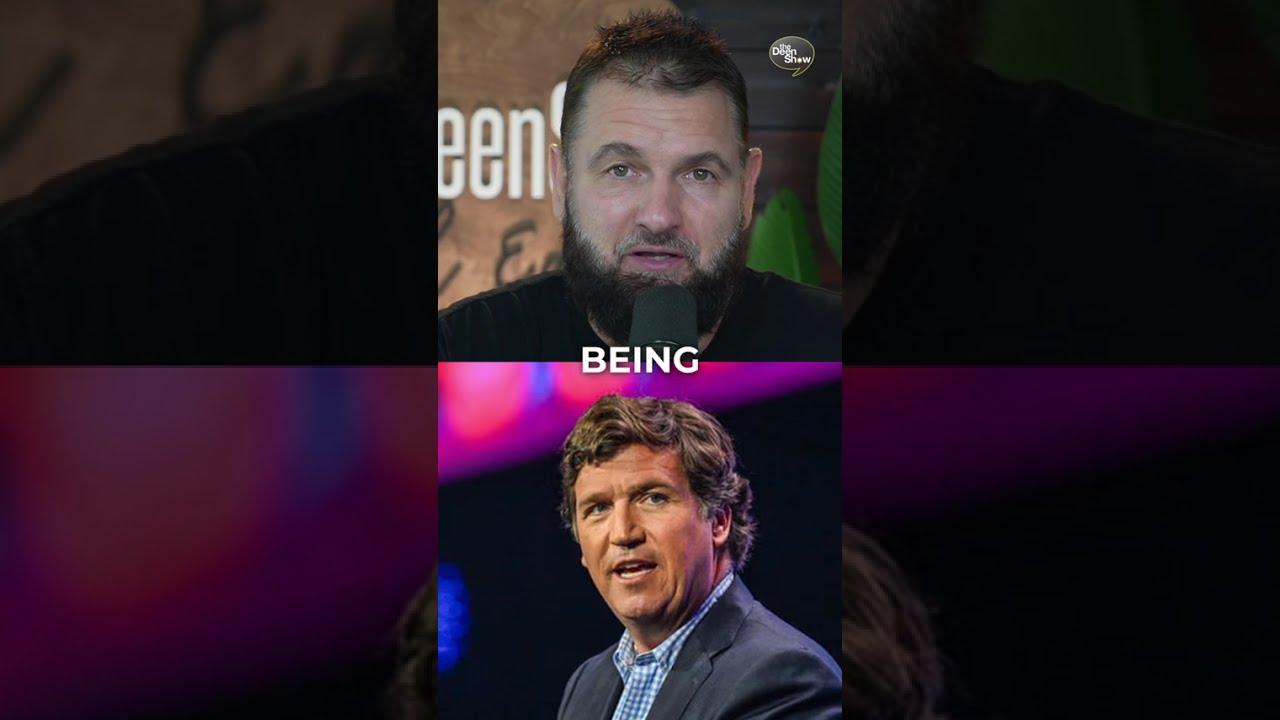

When COVID-19 locked down the world, it did something no political movement, environmental campaign, or philosophical treatise had managed to do in decades: it forced every human being on earth to stop and ask the same question simultaneously — What is this life actually for? In this episode, Eddie and his guest explore the pandemic not merely as a public health crisis but as a profound spiritual moment, one that carries real messages for those willing to hear them. Woven into the conversation is a candid clip of Hollywood actor Ben Affleck — twice in rehabilitation, openly battling depression and alcoholism, and searching with unmistakable sincerity for meaning and purpose — whose struggle becomes a mirror for millions living in a world of material abundance but spiritual emptiness. What emerges is a compelling case that the clarity, coherence, and compassion of Islam speaks directly to that emptiness in a way that nothing else quite does.
When the World Stopped Moving — and the Earth Began to Heal
One of the most striking dimensions of the pandemic, as the guest observes, was what happened to the planet the moment human activity slowed. Satellite imagery showed smog vanishing from major Chinese cities within weeks. The canals of Venice ran clear for the first time in living memory. Dolphins appeared in harbours. People heard birdsong in city streets — some for the very first time. These images were not sentimental footnotes; they were a stark diagnosis. Our relentless consumerism, our addiction to travel, to accumulation, to the perpetual noise of modern living, had been quietly devastating the natural world. The pandemic, in its disruption, briefly reversed that damage — and in doing so, issued a challenge to every person watching: is this how we want to live? From an Islamic perspective, this is not a coincidence but a sign. The Quran repeatedly calls on humanity to reflect on the world around them, and Islamic teachings have always connected environmental stewardship with tawakkul — trust in and accountability before the Creator. Alongside this environmental awakening came a reordering of values: the people who kept civilisation running during the crisis were not billionaires or celebrities but nurses, carers, delivery drivers, and farmers — a realignment that Islam has always affirmed, placing service, humility, and care for others at the heart of a meaningful life.
“If you hear of an outbreak of plague in a land, do not enter it; but if the plague breaks out in a place while you are in it, do not leave that place.” — Prophet Muhammad ﷺ, over 1,400 years ago
- Prophetic guidance, 14 centuries ahead of its time: The hadith on quarantine — stay out of afflicted lands; don’t flee if the plague reaches you — mirrors modern epidemiology with stunning precision.
- The reward of patient endurance: A companion hadith teaches that one who remains at home during plague, patient and trusting in Allah’s decree, earns the reward of a martyr — SubhanAllah.
- Islamic optimism as a spiritual discipline: The Prophet ﷺ taught that the believer’s situation is always good — gratitude in blessing, patience in trial. This is not naïve positivity; it is a trained, faith-rooted response to reality.
- The pandemic as environmental correction: Reduced flights, factory shutdowns, and quieter roads produced measurable improvements in air quality and biodiversity — a reminder that the planet’s health and our choices are inseparable.
- A global moment of shared humanity: For the first time, a single crisis touched every nation simultaneously, underscoring the Islamic teaching that all of humanity descends from one man and one woman — we are, in the deepest sense, one family.
Ben Affleck, the Crisis of Purposelessness, and What Islam Uniquely Offers
When Eddie plays the clip of Ben Affleck — one of the most recognisable names in Hollywood — speaking with genuine vulnerability about depression, antidepressants, alcoholism, and a lifelong struggle to find faith that makes both emotional and intellectual sense, the guest’s response is immediate and empathetic: this is not a celebrity problem, this is the human problem. Affleck admits he is drawn to Christianity, finds beauty in the Beatitudes, takes his children to church — yet cannot fully embrace a theology built around the Trinity, original sin, and vicarious atonement. He senses the truth somewhere but cannot locate it with confidence. The guest identifies this precisely: the teachings of Jesus (peace be upon him) are beautiful, but, as he notes, Christianity is not the religion of Jesus — it is a religion about Jesus, overlaid with centuries of human theology that strains the intellect of any sincere, thinking person. Islam, by contrast, asks nothing theologically impossible. It does not require a believer to accept that God died or that an innocent person’s blood pays for another’s sin. It offers instead a relationship of direct accountability: you sin, you recognise it, you turn to Allah sincerely, and He forgives you — and not merely wipes the slate clean, but, as Islamic tradition teaches, replaces those sins with good deeds in proportion to the sincerity of repentance. The episode also addresses the specific challenge of alcohol — a substance Islam prohibits absolutely, with no ambiguity and no cultural negotiation. For someone like Affleck, whose struggle with drinking escalated in the absence of clear boundaries, the contrast is telling. Islam tells you: do not drink, do not carry it, do not sell it, do not sit at a table where it is served. These are not arbitrary rules; they are a prophylactic system — designed not just to forbid the sin, but to close off the pathways that lead to it. The same principle applies to interactions between unrelated men and women. These clear divine guidelines, converts consistently report, are among the most liberating aspects of embracing Islam — not a cage, but a map.
- Purposelessness as a root cause of depression: The absence of a coherent answer to “why am I here?” is identified as one of the most significant — and underacknowledged — drivers of mental health struggles in the modern world.
- The intellectual honesty Islam demands and rewards: Unlike systems that ask believers to suspend reason, Islam invites rigorous thinking — its theology is internally consistent, its claims historically verifiable, its moral framework rationally defensible.
- Tawbah — the direct path back to God: No priest, no confession box, no blood sacrifice. Sincere repentance, directly to Allah, is accepted — and met with mercy beyond what the believer deserves.
- Clear halal/haram boundaries as a form of mercy: Knowing exactly what is permitted and what is not removes the exhausting moral ambiguity that traps people in cycles of compromise and self-justification.
- Every disease has a cure: The Prophetic teaching that Allah has not created a disease without also creating its cure motivated Islamic civilisation to lead the world in medicine, chemistry, and science — faith as the engine of healing.
- Courage is required — and worth it: As the guest acknowledges, accepting Islam is not the path of least resistance in today’s world. But the world needs it desperately — and those who have made that step consistently describe finding the peace and purpose they had been searching for their entire lives.
“How wonderful is the situation of the believer — for his affairs are all good. If something good happens to him, he is thankful for it and that is good for him. If something bad happens to him, he bears it with patient perseverance and that is good for him.” — Prophet Muhammad ﷺ
The pandemic year asked humanity a question it had been avoiding for a long time: are we living in a way that makes sense — for our souls, for one another, and for the world we have been entrusted with? Islam has always had an answer to that question, one grounded not in theological guesswork or cultural habit but in clear divine revelation, verified Prophetic guidance, and a complete framework for living that addresses the human being’s deepest needs. Ben Affleck’s search for meaning is not his alone — it is the search of every person who has looked at the accumulation of wealth, status, and distraction and found them hollow. The Deen Show has always sought to meet that search honestly, to clear away misconceptions, and to invite people to look at Islam not through the lens of media caricature but through its actual teachings, its intellectual coherence, and the transformative impact it has on those who embrace it with sincerity. May Allah guide every sincere seeker to the light and clarity of Islam, and may this extraordinary season of trial have planted seeds — of reflection, of gratitude, of genuine spiritual inquiry — that bear fruit long after the crisis itself has passed.