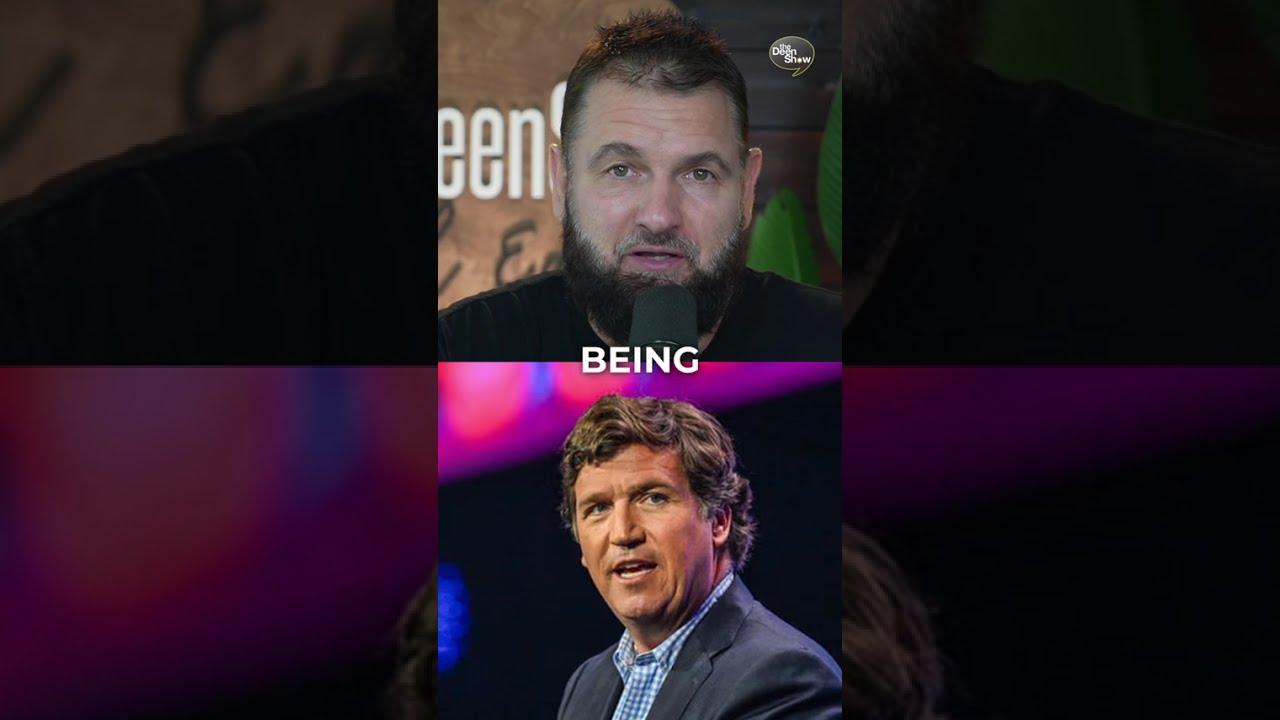
Every week, millions of people quietly wrestle with the most consequential question a human being can ask: does God exist? In this episode of The Deen Show, host Eddie speaks with Yusuf Estes — a former Christian Youth Minister and now one of the most recognisable voices in Islamic da’wah — about how to have a genuine, evidence-based dialogue with someone who identifies as an atheist. With over 1.5 billion Muslims worldwide, Islam is simultaneously the fastest-growing and most misunderstood way of life on earth; and few conversations reveal that misunderstanding more sharply than an honest, open exchange about faith, purpose, and the rational case for a Creator. This episode offers not heated argument, but calm logic — the kind that starts with what you can see with your own eyes.
The Universe Is the Argument: Order, Design, and the Rational Case for a Creator
The case for God’s existence begins not in a theology classroom but at your own desk. Look at a pen, a shoe, a skyscraper — every manufactured object has a maker, a purpose, a deliberate design. Yet when confronted with something infinitely more complex — the precise axial tilt of the Earth that makes all biological life possible, the elliptical orbits of planets that never collide, the molecular architecture of a single protein — some people insist there was no Designer. Yusuf Estes walks through several analogies in this episode that make the logical contradiction impossible to dismiss:
- The Mercedes in the bin: Take every single part needed to build a Mercedes, throw them into a container, detonate a bomb — you get chaos, not a car. The more explosions you add, the further from a functioning vehicle you get. A Big Bang producing a perfectly ordered cosmos is exponentially more implausible.
- The tornado in the junkyard: A tornado ripping through a salvage yard cannot assemble a working automobile. Explosions yield disorder. The cosmos, from subatomic particles to galactic clusters, displays precisely the opposite of disorder.
- The watch in the desert: Finding a watch, you instinctively ask who made it — you do not assume it self-assembled. The human eye, the beating heart, the chlorophyll cycle: these are watches of staggering complexity, found everywhere we look.
- Macro and micro mirror each other: Electrons orbit protons in spherical paths; planets orbit stars in elliptical ones. The same architectural signature from the quantum level to the astronomical — pointing to a single, unified Designer.
- A protein cannot form by accident: Scientists acknowledge that even if all the elements in the universe were combined and recombined for billions of years, the first molecule of protein — the building block of all life — could not arise by chance alone.
- The Quran preceded modern science: Fourteen hundred years ago, the Quran stated that all life was brought forth from water. Modern biology confirms this. This is not coincidence; it is divine knowledge transmitted through the final Prophet, peace be upon him.
“Even God says in the Quran — the final revelation of mankind — if you want evidence of My existence, look inside yourself. That should be more than sufficient evidence to realise that I am the Creator.” — Yusuf Estes, The Deen Show
Why Most Atheists Are Not Really Atheists — The Emotional Root of Disbelief
Here the conversation takes its most compassionate and psychologically honest turn. The overwhelming majority of people who call themselves atheists did not arrive at disbelief through rigorous scientific inquiry — they arrived there through pain. A sister killed in a car accident when they were ten. A mother lost to cancer with no explanation that made sense. Suffering that cried out for an answer and received none. As Yusuf Estes states plainly: “Nobody is born an atheist.” Something breaks the heart and goes unanswered, and the most emotionally immediate response is to deny the God they feel abandoned by. Classical Islamic scholarship — including the penetrating analysis of Shaykh al-Islam Ibn Taymiyyah (may Allah have mercy on him) — confirms this same insight: many who outwardly deny Allah still sense His existence deep within, suppressed beneath layers of grief, arrogance, or unresolved doubt. Atheism, in this reading, is less a philosophical position than a spiritual wound in need of healing.
- Atheism is almost always emotional, not philosophical: Most self-described atheists cite a personal tragedy or disillusionment — not a scientific discovery — as the turning point in their disbelief.
- The fitrah is innate: Islam teaches that every soul is born with a natural disposition (fitrah) toward recognising its Creator. Disbelief is always acquired — something taught, absorbed, or adopted after encounter with hardship or misguidance.
- The Quran addresses suffering directly: Unlike atheism, which offers no framework for suffering beyond random misfortune, the Quran explains tests and trials, their purpose, and what they mean within the broader design of creation.
- Guidance belongs to Allah: The Muslim engaged in da’wah is reminded — as Yusuf Estes emphasises in this episode — that it is Allah who guides hearts, not the eloquence of any argument. Your role is to convey clearly, with wisdom and care.
- Islam’s concept of God stands apart: The Islamic understanding of Allah — utterly distinct from and independent of His creation, needing nothing from it while everything depends entirely on Him — is unique among world religions and resonates with both reason and the human heart.
“Were you created from nothing, or did you create yourselves? Did you create the fire you kindle, or the rain you drink? If I had wished, I would have made it salty so you could not drink it.” — Allah, Quran, Surah Al-Waqi’ah, Chapter 56, as cited on The Deen Show
Purpose, Accountability, and Why This Life Is Only the Beginning
Perhaps the most devastating argument against atheism is not cosmological but existential: without a Creator, there is no ultimate purpose and no ultimate justice. If there is no accountability beyond the grave, then cruelty, oppression, and exploitation carry no final consequence — the scales are never balanced, and the innocent who suffered unjustly simply vanish into nothingness. Islam’s answer is clear, rational, and profoundly liberating: this life is not the destination — it is the opening chapter. Allah did not place humanity on earth to live for fifty or eighty years and dissolve into non-existence. The purpose is worship in the comprehensive Islamic sense: aligning every thought, intention, relationship, and action with the One who designed and sustains all of it. When you truly understand that what you sow is what you reap — that the investment of this brief life determines the outcome of the eternal one — then the call of Islam is not a burden but a mercy. For the seeker who has turned away from God out of anger, confusion, or unanswered questions, the message of this episode is not condemnation but an open invitation: pick up the Quran, engage honestly with the evidence around you and within you, and let reason do what it was always designed to do — lead you home. Surrender and submission to the Creator of the heavens and the earth is not the defeat of the intellect; it is the intellect arriving, at last, at its most honest and courageous conclusion.