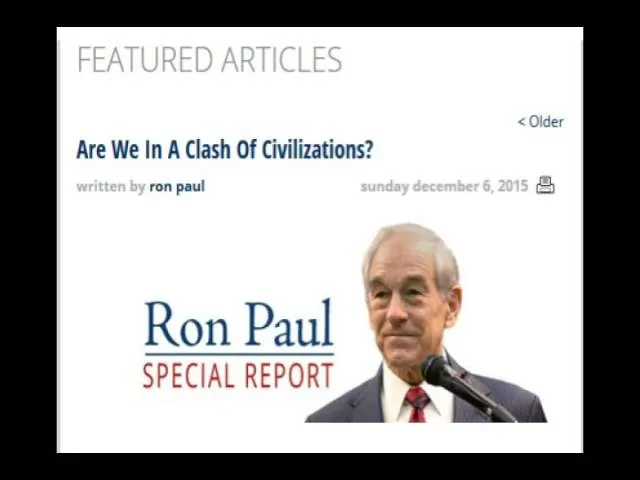
When a sitting congressman and former presidential candidate declares that the so-called “war against Islam” is a manufactured narrative — not a genuine clash of civilizations — every person of faith, conscience, and intellectual honesty is obliged to listen carefully. Congressman Ron Paul, a rare voice of principled dissent in American political life, argues with striking clarity that framing 1.7 billion Muslims as an existential threat to Western civilization is not a reflection of spiritual reality or authentic conflict between peoples of faith — it is war propaganda, engineered by neoconservative interests to justify military empire. For Muslims navigating a world where their faith, their identity, and their very humanity are routinely questioned, Paul’s analysis offers not just political insight but a form of honest historical reckoning that the mainstream media consistently refuses to provide.
Fear as a Political Weapon: How the “Clash” Narrative Serves the Powerful, Not the People
Paul draws a distinction that is deliberately blurred in mainstream political discourse: acknowledging that groups like ISIS and Al-Qaeda exist is not the same as accepting that they represent Islam or the world’s Muslim population. ISIS deliberately manipulates the spiritual language of Islam to inspire violence and recruit followers — this is calculated political strategy, not a reflection of the faith or its 1.7 billion adherents. As Paul observes, claiming that ISIS represents Islam is no more valid than claiming the KKK represents sound Christian theology. The real engine driving the clash of civilizations narrative, Paul argues, is ruthless pragmatism — war requires an enemy, and that enemy must be demonised convincingly enough to override public reason and sacrifice. Key takeaways from his analysis include:
- The violence attributed to a fringe minority of Muslims — a group without an army, navy, or air force — is systematically exaggerated to manufacture a sense of existential civilisational threat.
- The Iraq War was built on documented lies and deliberate fear-mongering; the same neoconservative playbook continues to justify ongoing military intervention across the Muslim world.
- US foreign policy has a documented history of covertly supporting the very groups — including Hamas precursors and the Mujahideen — that are later invoked to justify further wars against Muslim-majority nations.
- America’s deep strategic alliance with Saudi Arabia, a state that enforces Sharia law, exposes the profound hypocrisy at the core of any genuine “war on Islam” framing.
- Samuel Huntington’s 1996 Clash of Civilizations thesis, developed in alliance with neoconservative think tanks, provided the intellectual scaffolding for post-9/11 war rhetoric long before the attacks occurred.
- Neoconservatives — not foreign invaders — represent the greatest domestic threat to liberty, using civilisational fear to erode civil rights and concentrate power at home.
“Claiming that they alone are responsible for the great ‘clash’ is purposely misleading. That misunderstanding is required by Western propagandists to gain public support for their wars in the Middle East, and for a continuation of the American Empire.” — Ron Paul
Blowback, Empire, and What the Muslim World Sees That Many in the West Refuse to Acknowledge
Among the most honest — and most suppressed — insights in Paul’s analysis is the concept of blowback: the predictable, documented consequence of empire-building in Muslim-majority lands. The death of four million Muslims in the Middle East over fourteen years of Western military intervention is not an abstraction — it is a humanitarian catastrophe that has shattered entire societies, displaced tens of millions of people, and generated the precise conditions of grief, humiliation, and desperation in which extremist recruitment flourishes. Paul identifies a clear and repeating sequence: powerful financial interests pursue empire and control of natural resources; occupied populations resist; puppet dictators are installed by force to suppress that resistance; and finally, both sides produce reactionary groups motivated by anger, cultural injury, and the determination to expel foreign occupiers. The more violent the military response to groups like ISIS, the easier recruitment becomes — the cycle feeds and sustains itself by design. Meanwhile, the people of the Muslim world perceive what many Americans are never told: that Western military presence is not about spreading freedom or Islamic-values-compatible governance, but about controlling resources, propping up compliant regimes, and serving the interests of a military-industrial complex that profits from perpetual conflict. The guidance of Islam — which calls believers unequivocally to justice, truthfulness, and solidarity with the oppressed — demands that Muslims and all people of conscience refuse to accept this manipulated narrative at face value.
“The harder we work at remaking the Middle East, the worse the conditions become — with an ever stronger and more dangerous Al-Qaeda and ISIS. The more violent our military responses to ISIS, the easier it is for more jihadists to be recruited to its cause.” — Ron Paul
Reclaiming Truth: What Honest Spirituality and Political Clarity Demand of Us
What Ron Paul’s courageous analysis ultimately offers is a call to reclaim truth in a landscape saturated with purposeful falsehood — and for Muslims grounded in faith, that call resonates deeply with the very foundations of Islam. The deen of nearly two billion people cannot and must not be reduced to the actions of a fringe that deliberately distorts sacred texts for geopolitical ends. The Quran’s commands of justice, the prophetic tradition of mercy and peacemaking, and fourteen centuries of Islamic civilisation — its scholarship, science, ethics, philosophy, and history of coexistence — stand as enduring testimony against the caricature that fear-driven war propaganda requires. Paul’s own guiding principle — the rejection of all aggression as a method for individuals or governments to alter society — is not distant from the Islamic ethical tradition, which holds the sanctity of human life, the pursuit of justice, and the preservation of peace among its highest obligations. The path forward, for Muslims and for all people of sincere faith and clear conscience, is neither despair nor the reactive radicalism that empire-builders cynically count on — it is clarity of understanding, solidarity across communities, and the patient, principled work of bearing witness to truth. As this conversation with Ron Paul reminds us, the growing hunger for honest governance, real liberty, and genuine peace among a new generation is not a small thing — it is, perhaps, the most meaningful source of hope in a world that powerful interests have worked very hard to keep afraid.