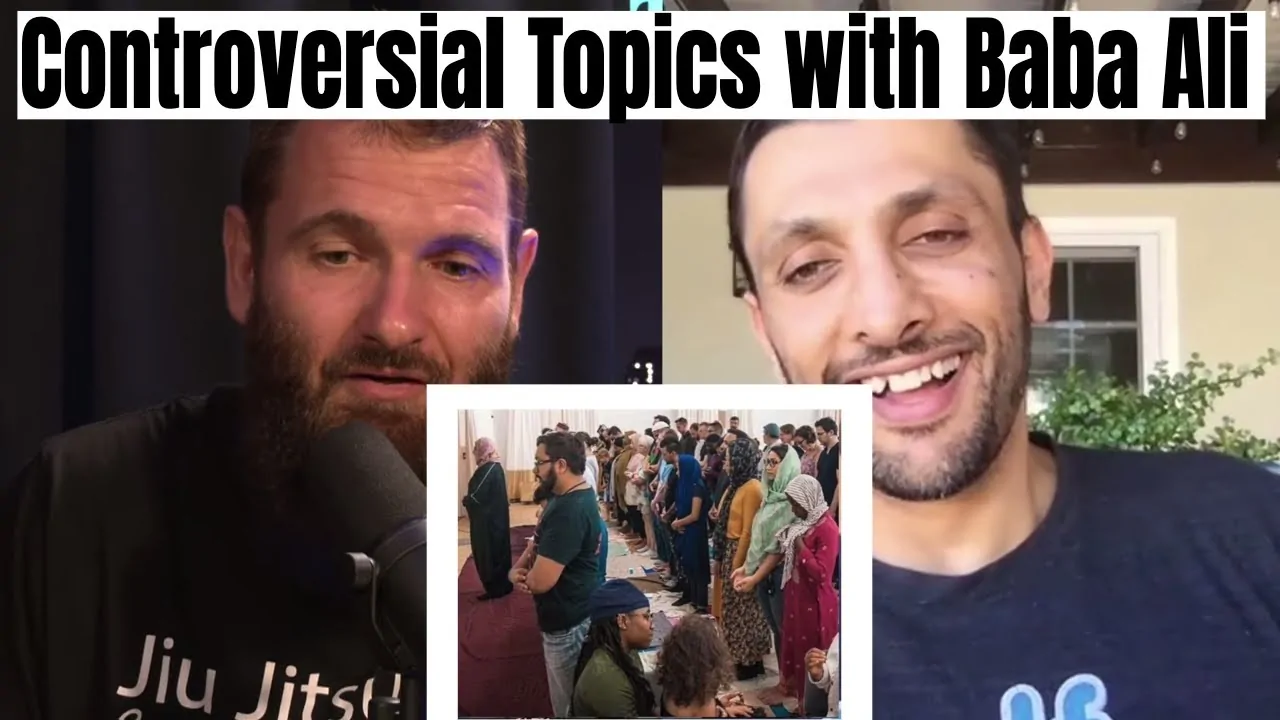
The image is arresting — a woman standing at the front of a mixed congregation, leading the rows in salah. For Muslims grounded in the Quran and Sunnah, the scene immediately raises the question: where does this come from, and what is its evidence? In this episode of The Deen Show, comedian and content creator Baba Ali joins host Eddie to tackle exactly these kinds of uncomfortable, generation-defining questions — navigating everything from pandemic-era spiritual lessons to the systematic erosion of evidence-based Islamic practice in an age saturated with media manipulation, emotional religion, and borrowed ideology.
What the Pandemic Taught Us About Allah’s Control — and Why Critical Thinking Is an Act of Faith
The conversation opens on a reflective note: far from being purely a catastrophe, the global pandemic carried unexpected spiritual gifts for many Muslims. Forced stillness stripped away the distractions of normal Ramadan life, and many reported their most focused, heartfelt Ramadan in years. That clarity, both speakers agree, is a reminder that Allah subhanahu wa ta’ala controls everything — including, as Baba Ali puts it, “the smallest thing our eyes can’t even see” that can reshape the entire world overnight. Yet alongside this lesson in tawakkul runs a sobering observation about the information environment we inhabit. Media channels, Baba Ali explains, do not simply inform — they direct attention, shift narratives, and serve the agendas of those who fund them. The coronavirus dominated every screen, then vanished overnight when the next crisis emerged; the situations in Syria and Yemen disappeared from public consciousness entirely. The believer, both hosts agree, must cultivate active, discerning awareness rooted in Islamic guidance rather than passive, fear-driven consumption of whoever shouts loudest.
- Trials deepen tawakkul: Hardship reminds the believer of complete dependence on Allah, especially when the threat is invisible and beyond human control.
- The media narrative is managed: Mainstream channels switch focus from crisis to crisis, keeping audiences in reactive fear rather than genuinely informed awareness — and Muslims are not immune to this manipulation.
- Verify through multiple sources: Just as hadith scholars cross-verified narrations through multiple chains of transmission, modern Muslims must cross-reference across independent sources rather than relying on agenda-driven outlets that function as “comfort food” — telling audiences only what they already want to hear.
- Make du’a for clarity: The Prophet ﷺ taught us to ask Allah to show us truth as truth and falsehood as falsehood — a supplication for epistemological guidance, not merely personal reassurance.
- Islam commands rational inquiry: The Quran itself instructs believers to verify what they receive. Critical thinking is not a secular import — it is a Quranic obligation.
“Once you open this door and we’re not using Quran and Sunnah as evidence anymore, then the floodgates get completely open — you can make up anything you like.” — Baba Ali
Women Leading Salah, Imam Malik’s Principle, and the Non-Negotiability of Evidence
The episode’s sharpest moment arrives when the image of a woman leading a mixed congregation in salah enters the discussion — a scene Baba Ali compares to one of those visual puzzles where everything seems superficially normal until you look carefully and realise something is fundamentally wrong. He is careful to frame the point precisely: this is not a claim about the relative worth or dignity of men and women, which Islam affirms with complete clarity. The issue is authority of evidence. Islamic practice is not determined by cultural trends, what feels progressive, or what “makes people feel good” — it is determined by what Allah has revealed in the Quran and what the Prophet ﷺ demonstrated through his Sunnah. The episode draws a direct and sobering parallel between uncritical media consumption and uncritical religious innovation: when a community stops asking “what is the daleel?”, the door swings open for any reinvention of the faith. Baba Ali invokes the principle attributed to Imam Malik, rahimahullah: what was not part of the deen in the time of the Prophet ﷺ and his Companions is not part of the deen today. The Quran has not changed. The authentic hadiths have not changed. What has changed is human pride — the Iblis-like insistence that our reasoning or our feelings ought to supersede divine revelation.
- Evidence anchors legitimate difference of opinion: Scholarly differences throughout Islamic history — on hand position in salah, for example — were always grounded in textual proof, not personal preference or social pressure.
- Abandoning the standard opens everything: Once Quran and Sunnah become optional, there is no principled limit to what can be reinvented — prayer direction, modesty, the pillars themselves become negotiable.
- Imam Malik’s principle endures: What was not established as deen in the prophetic era cannot be introduced as deen today, regardless of how emotionally compelling the argument sounds.
- Islam is based on proof, not popularity: Its intellectual integrity — its demand for evidence, its preserved chain of narration, its unchanged text across 1,400 years — is precisely what draws sincere seekers to it upon honest investigation.
“Islam has taught us to think — don’t just worship what your parents have worshipped. Use your brain, and you will see very clearly that Islam is the truth, that Allah is Al-Haqq.” — Baba Ali
At the heart of this conversation lies a timeless tension between submission and ego — between the humility that says “Allah knows best” and the arrogance that insists “I know better.” The Deen Show has always sought to hold that tension honestly, engaging real questions with real evidence rather than deflection or false reassurance. Whether the topic is finding spiritual purpose in a global pandemic, navigating a media landscape designed to keep us misinformed and afraid, or understanding why a woman does not lead men in the obligatory congregational prayer, the call is the same: return to authentic sources, verify what you believe, seek knowledge from credible scholars, and resist the comfort food of confirmation bias — whether it comes from a cable news anchor or a religious influencer chasing clicks. Islam is not a faith of “have it your way.” It is a perfected, complete way of life, revealed to the final Messenger ﷺ and preserved with extraordinary care for every generation that follows — including ours, in an era when that preservation demands more active, critical, and spiritually grounded effort than ever before.