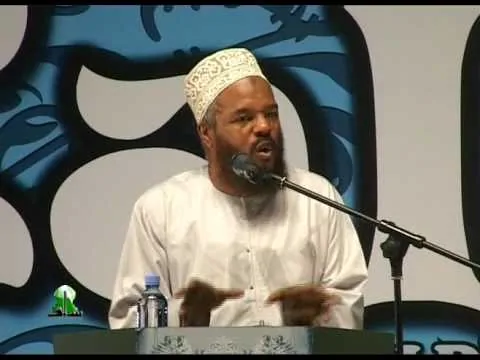
Before we depart this world, we will each be asked three questions — and they will determine everything. According to a hadith narrated by multiple companions of the Prophet Muhammad (peace be upon him), when a person enters the barzakh — the spirit world from which there is no return — two angels will sit them upright and demand answers: Who is your Lord? What was your religion? Who was your Prophet? In this landmark lecture, Dr. Abu Ameenah Bilal Philips confronts a truth many Muslims find deeply uncomfortable: simply saying “Allah” in this life is not the same as knowing Allah. And in the grave, the distance between those two things will become devastatingly clear. The Prophet (peace be upon him) taught that those who truly knew their Lord will answer with ease, and the grave will become a garden from the gardens of Paradise — while those who did not, even if they were culturally regarded as Muslims, will only stutter: “Ah… I don’t know.”
Five Questions That Reveal How Well You Know Your Lord
Allah warns in Surah Yusuf (12:106) that most of those who claim to believe in Him still worship others besides Him — a grave reminder that this issue carries enormous weight for our spiritual safety in both this life and the next. Dr. Bilal Philips poses five razor-sharp questions to help us honestly assess the depth of our knowledge of Allah. If any of these leaves us stumped, it is a sign that our understanding of our Lord needs urgent attention — because without that foundation, we remain vulnerable to misguidance, false ideologies, and the whisperings that erode faith:
- Is belief in God a matter of blind faith? No — and the very founders of Western logic prove it. Plato and Aristotle, the greatest philosophers of the ancient world, both argued rationally for God’s existence. The principle that design implies a designer is not faith — it is common sense. A footprint in the sand tells us someone walked there; the breathtaking design woven into every snowflake, every grain of sand, every atom of creation tells us Someone designed it all. It is atheism, not belief, that rests on blind faith.
- If everything has a Creator, who created God? This question answers itself. If God is defined as the uncaused First Cause — without beginning and without end — then asking who created Him is logically incoherent. As Aristotle argued, an infinite chain of creators leading to infinity is equivalent to having no origin at all. Our very existence proves there must be an uncreated origin, One who stands outside the process of creation itself.
- If God can do anything, why can’t He have a son? Omnipotence does not mean God can perform ungodly acts — acts that would strip Him of His very nature as God. Being born, ageing, and dying are attributes of creation, not the Creator. Any question that asks God to do something that contradicts His divine attributes is not a philosophical challenge — it is a logical contradiction dressed up as one.
- Can God create a stone too heavy for Him to lift? This is a deliberately absurd question, not a genuine puzzle. If such a stone could exist, it would imply something greater than God — which is a contradiction in terms. The question collapses under its own premise. Those who are confused by it simply do not yet know who their Lord is.
- If God is all-good and all-powerful, where did evil come from? Evil does not originate from a rival deity or from Satan acting independently of Allah. The Quran is unambiguous: Allah is the Creator of everything, and nothing takes place in His creation except by His permission — always with wisdom behind it, even when we cannot see it. To assign the creation of evil to Satan alone is to fall into the theological error of those who believe in more than one god.
“Knowledge of whom our Lord is is the foundation of our faith. How can we believe in our Lord if we don’t know who He is? If these questions are unclear to us, we will be open to false calls, to misguidance — and we will fall into them, because we didn’t know who our Lord was.” — Dr. Bilal Philips
Every Cloud Has a Silver Lining — The Islamic Answer to Suffering and Evil
The most emotionally resonant part of Dr. Bilal Philips’ lecture addresses the hardest question of all: why does suffering exist if Allah is good and all-powerful? Drawing on the story of Prophet Musa (Moses) and Al-Khidr in Surah Al-Kahf — the chapter we are encouraged to read and reflect upon every Friday — Dr. Philips illustrates two categories of apparent evil. The first: evil whose hidden good we eventually see in this life. When Al-Khidr broke a hole in the boatman’s vessel, it looked like senseless cruelty — until a tyrant came to seize every seaworthy boat on the river. The broken boat was passed over, and the man’s livelihood was spared. Dr. Philips shares a modern parallel: a teacher in Egypt who missed his Gulf Air flight home to Bahrain because of a missing passport stamp, shattered and weeping — only to wake the next morning to headlines reporting the flight had crashed with no survivors. What he called a calamity had been, in truth, a mercy. The second category is harder: evil whose good we will not see or understand until the Day of Judgment itself, as illustrated when Al-Khidr took the life of a young boy to spare his righteous parents from the spiritual ruin that boy would one day have brought upon them. Both stories point to the same truth about faith, purpose, and the nature of our Lord:
- Allah alone is the Creator of everything — good and evil alike exist only by His permission and within His sovereignty.
- Every hardship contains an element of good: either one we will eventually recognise in this life, or one revealed to us only on the Day of Judgment.
- Patience and trust in Allah’s wisdom — tawakkul — is not naivety. It is the rational response of a soul that truly knows its Lord.
- A child who screams at the dentist’s needle does not understand that a small pain is preventing a greater one. Our relationship with the trials Allah permits in our lives is not so different — the difference is in our level of knowledge and trust.
“Every evil incident which takes place has behind it an element of good for which God permitted that evil to take place. As they say, every cloud has a silver lining — and this is what is illustrated in the story of Moses and Al-Khidr in the Quran.” — Dr. Bilal Philips
True knowledge of Allah is not an academic exercise — it is the armour that protects a believer’s faith from corrosion in a world full of doubt, philosophical challenges, and spiritual confusion. When we understand that belief in God is the most rational position a human being can hold; when we know that Allah is uncaused, uncreated, and beyond the logic of creation; when we grasp that His attributes of perfection mean certain questions about Him are simply incoherent rather than unanswered; and when we trust that every hardship conceals a mercy beyond our immediate sight — we are equipped to answer the angels with certainty, to resist the calls of misguidance with confidence, and to live with the clarity and purpose that Islam offers every searching soul. The question Who is your Lord? is not asked only in the grave. It is being asked of us right now, in this life, while we still have the time and the opportunity to learn — and to truly know — the answer.