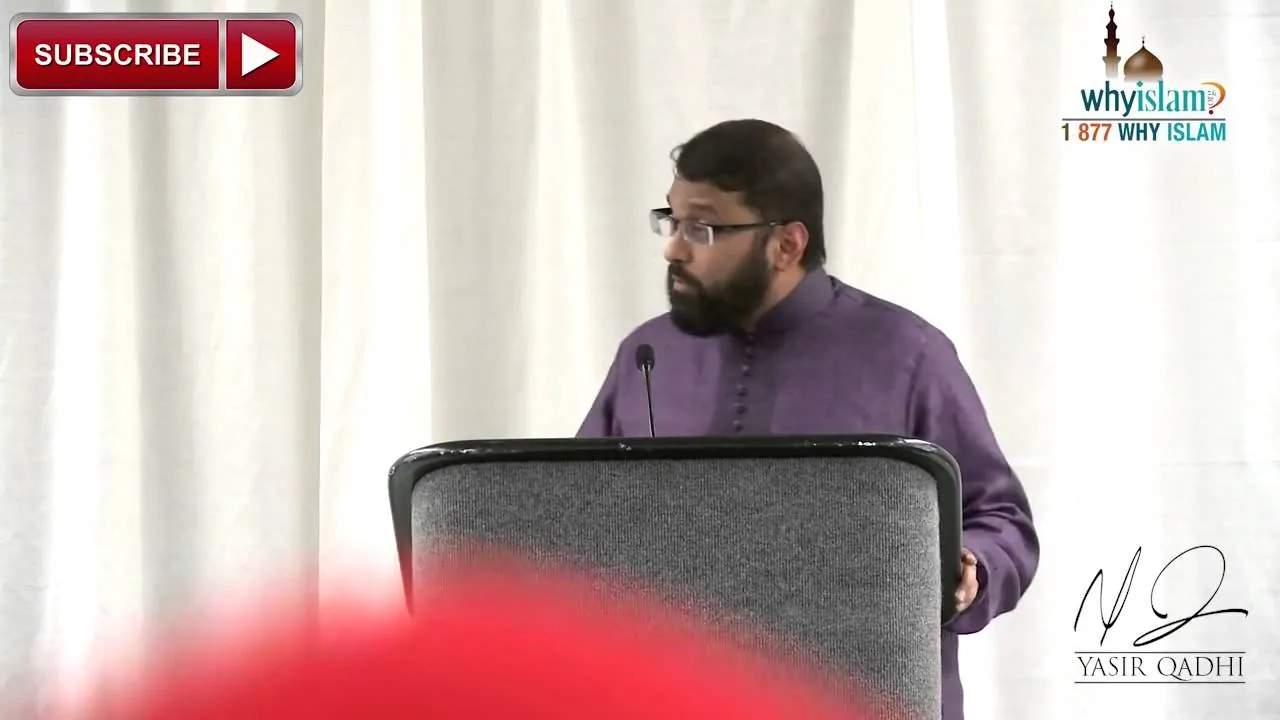
What does it truly mean to live a good life? For most people in the modern West, the answer is deceptively simple: a stable career, a mortgaged home, two cars, a comfortable family — the hallmarks of what has come to be known as the American Dream. Yet even those who achieve this vision often find themselves confronted, especially in middle age, with a quiet but insistent question: is this all there is? In a landmark talk delivered in Detroit in May 2014, Shaykh Dr. Yasir Qadhi — scholar, professor, and one of the most influential Muslim voices in the English-speaking world — takes this universal restlessness and uses it as a launchpad for a profound journey through faith, reason, and the Islamic understanding of humanity’s purpose. Drawing on Quranic wisdom, rational philosophy, and the lived reality of modern Western society, he walks his audience through five essential questions that every sincere seeker of truth must confront.
The Evidence All Around Us: Proving God, Morality, and the Reality of Evil
Shaykh Yasir Qadhi begins where the conversation must begin in our secular age: does God even exist? He notes that a generation ago this question would have been unnecessary, but today — with roughly a third of young Americans unaffiliated with any religion — it must be answered head-on. His response is characteristically direct: the existence of creation is itself proof of a Creator. The “watchmaker argument,” as philosophers call it, is not mere sophistry — it is common sense. Every watch implies a watchmaker; every intricate, perfectly balanced universe implies an infinitely wise Architect. Beyond the cosmological argument, the Shaykh draws on the moral argument: humanity universally recognises justice, mercy, and dignity as real values. Even the criminal does not wish to be robbed; even the oppressor knows oppression is wrong. This shared moral conscience, he argues, did not emerge from random evolutionary forces — it was placed within us by Allah, Al-Jameel, who loves beauty and instilled these noble qualities in the human soul. He then addresses the most powerful objection to theism in our times — the existence of evil — with clarity and compassion: evil is sometimes relative (like the pain of a vaccination that brings greater health); evil reveals and enables good (without poverty, how do we exercise generosity? without orphans, how do we demonstrate mercy?); evil is a divine trial that distinguishes the sincere from the insincere; and — most fundamentally — Jannah is the next life, not this one. Those who demand that this world be paradise have simply misunderstood what this world is for.
“And most of mankind — if you are eager — will not be believers… he adhered to the earth and followed his own desire. So his example is like that of the dog: if you chase him, he pants, or if you leave him, he (still) pants. That is the example of the people who denied Our signs.” — Sūrat Al-A’rāf, 7:176
- Creation proves the Creator: The existence of a perfectly ordered universe is the simplest and most watertight evidence for the existence of Allah.
- Morality points to God: Universal human values — justice, mercy, dignity — cannot be explained by materialism alone; they reflect the qualities Allah placed within every soul.
- Every person worships something: Whether money, ideology, or a social cause, every human being is hard-wired to seek a higher purpose — Islam provides the ultimate answer.
- Evil does not disprove God: It is relative, it enables virtue, it is a test, and this world was never meant to be paradise — Jannah awaits those who pass the examination of this life.
- “Spiritual but not religious” is logically incoherent: If a perfectly ordered Creator exists, it is inconceivable He would leave each of one billion people to invent their own morality and theology.
Why Organised Religion, Why Prophets — and Why Islam
Having established that Allah exists and that He is a living, caring, actively involved God — not the distant clockmaker of Deism — Shaykh Yasir Qadhi turns to the next logical questions: why organised religion, and why Islam specifically? His argument is elegant: a God who has perfectly orchestrated the physical world, who gave us air to breathe and food to eat, cannot possibly be indifferent to our spiritual needs. Such a God must communicate guidance, and the most rational mechanism for that communication is prophethood — a chosen, purified, righteous human being sent with a divine message. When Westerners reject religion, the Shaykh reminds his audience, they are in reality rejecting their own specific experience with medieval Christianity. Islam’s golden age — its era of scientific, moral, and civilisational flourishing — coincided precisely with its deepest religious commitment. For us, religion and progress were never at war. As for why Islam over all other faiths, the Shaykh points to three pillars: the fully rational and internally consistent theology of Islam; the miracle of the Quran, whose literary and intellectual inimitability remains unchallenged; and the extraordinary life of the Prophet Muhammad ﷺ — an illiterate man from the Arabian desert who brought a teaching of such depth, coherence, and moral transformation that it reshaped the world. He concludes with a profoundly simple invitation he offers to every non-Muslim he meets: pray, without even mentioning a name — just say from the depths of your heart, “O You who created me, guide me to the straight path” — and trust that Allah does not misguide the one who is truly sincere.
“I have not created jinn and mankind except to worship Me.” — Sūrat Adh-Dhāriyāt, 51:56
- A caring God must send guidance: The same God who sustains our bodies cannot neglect our souls — prophethood is the most logical vehicle for divine communication.
- The critique of religion is really a critique of Christianity: Islam’s civilisational legacy is distinct — its greatest scientists, philosophers, and rulers flourished under, not despite, Islamic faith.
- Three proofs for Islam: The rational perfection of Islamic theology; the linguistic and intellectual miracle of the Quran; and the transformative life and character of the Prophet Muhammad ﷺ.
- The universal dua: Every seeker — regardless of background — can open the door to guidance simply by sincerely asking the Creator to show them the straight path.
- Our role is da’wah, not compulsion: Muslims show the road; Allah opens the hearts. Every sincere soul, the Shaykh assures us, will eventually be guided.
The American Dream, as Shaykh Yasir Qadhi so compellingly exposes, is not wrong in what it includes — comfort, family, stability are legitimate blessings — but in what it excludes: the acknowledgment that we were created for something infinitely greater than the satisfaction of our appetites. Islam does not ask us to abandon the world; it asks us to see through it, to recognise that every breath, every trial, every moment of beauty or hardship is part of a purposeful journey toward our Lord. Whether you are a lifelong Muslim whose faith has grown routine, or a sincere seeker who has never encountered these arguments laid out so clearly, the invitation of this talk is the same: raise your gaze, engage your God-given intellect, and ask the question that every human soul — beneath the noise of careers and mortgages and daily distraction — is already asking in its quietest moments. The straight path is real, the Creator is near, and as Shaykh Yasir Qadhi reminds us, Allah does not turn away the one who calls upon Him with a sincere heart.