Have you ever reached the end of a week and genuinely wondered where it went? Days blur into months, years dissolve before we can make sense of them — and yet we fill every hour with earning, spending, scrolling, and striving for more. This collective restlessness is not a modern invention; the Prophet Muhammad ﷺ named it fourteen centuries ago as one of the unmistakable signs that the Hour draws near. Understanding what he meant — and more importantly, what we are supposed to do about it — cuts to the heart of why Allah created us and what we are doing with the time He has entrusted to us.
When Time Loses Its Barakah: A Prophetic Sign We Are Already Living
“The Hour will not begin until time passes more quickly, so a year will be like a month, and a month will be like a week, and a week will be like a day, and a day will be like an hour, and an hour will be like the burning of a braid of palm leaves.” — Prophet Muhammad ﷺ (Ahmad 10560, classed sahih by al-Albani in Sahih al-Jami’)
The classical Islamic scholars debated extensively what taqaarub al-zamaan — the rapid passing of time — truly means, and their conclusions are as urgent today as when first written. The strongest scholarly view, favoured by Imam al-Nawawi, al-Qadi ‘Iyad, and al-Hafiz Ibn Hajar, is that the phrase carries both a metaphorical and a literal dimension. Metaphorically, barakah — divine blessing — is progressively withdrawn from time itself, so that a person accomplishes in a full day what they once accomplished in a single focused hour. Ibn Abi Jamrah observed that this removal of barakah extends into provision and agriculture, and that its root cause is the weakening of faith and the encroachment of what is haram or doubtful into our livelihoods. Literally, Shaykh Ibn Baaz noted that the compression of physical distances — journeys that once took months now taking hours — is itself a visible fulfilment of the prophecy. The scholars held that both meanings stand simultaneously, and there is no contradiction between them. Allah tells us plainly in Surah al-A’raf (7:96): “And if the people of the towns had believed and had taqwa, certainly We should have opened for them blessings from the heaven and the earth.” Barakah is not a relic of a simpler era — it is a living spiritual reality, gained through obedience and forfeited through heedlessness.
- Barakah determines the real value of time — a day without divine blessing yields less meaningful output than a focused hour lived in consciousness of Allah.
- Modern productivity cannot substitute for barakah — technology compresses distance and automates tasks, but it cannot restore the blessing that is withdrawn when faith weakens and haram enters our provision.
- The sign is already upon us — scholars from Ibn Hajar’s era onwards recorded that people of their own time were already complaining of the same bewildering rush that defines our lives today; it has only intensified.
- The remedy is taqwa, not time management — scheduling apps and productivity systems are no substitute for returning to Allah’s commands and cleansing our income and our hours of what displeases Him.
- Wealth and ease carry an implicit covenant — when Allah removes the burden of poverty, He expects the freed time to flow toward worship, family, and spiritual growth — not simply into more dunya.
Two Paths When Allah Gives You Enough: The Choice That Defines Your Life
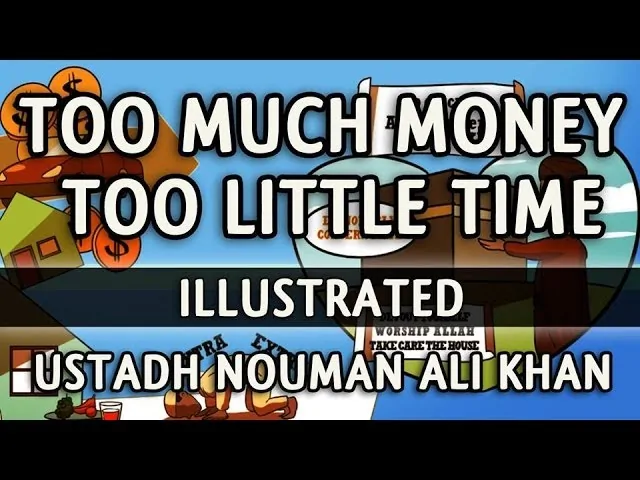
When Allah granted the Quraysh — custodians of His sacred House — economic prosperity, that gift came with a profound covenant: freedom from material anxiety was designed to free the heart for worship. Ibrahim ﷺ had made du’a that the hearts of people across the world would be drawn toward Allah’s House, and it followed that those charged with its care should cultivate the softest hearts of all. The same principle extends to every believer today. Wealth, in the Islamic worldview, is not an end in itself — it is an enabler that clears the obstacle of need so the believer can rise toward their true purpose. But provision always presents a fork in the road. A person of means can dive deeper into dunya, converting every spare hour into income and every surplus into luxury — or they can pause and recognise that Allah has already provided enough, and redirect the hours freed from necessity toward Quran, family, and ‘ibadah. A Muslim physician, when asked why he chose to work part-time despite having the skills to earn three times more, answered with a clarity that every income-earner should sit with:
“Allah didn’t create me to make more money. He created me for another purpose. So if I can survive doing less and do more meaningful things — memorise Quran, teach my kids, spend time with them — why not?” — from the podcast discussion
That question — why not? — deserves to settle in every Muslim household where the salary is already more than enough. The tragedy of the alternative is already unfolding in countless homes: a parent who traded every spare hour for a higher income, arriving home after the children have fallen asleep and leaving before they wake, buying toys as a substitute for presence, purchasing the unlimited phone plan and then wondering why the child never looks up from the screen. What we modelled for our children in their earliest years, they will reflect back to us in our old age — and no salary covers the cost of that distance. The Islamic path is not to abandon ambition or to condemn wealth; it is to interrogate both with sincerity. When provision is generous and time is genuinely freed, the believer’s instinct should be to ask: why has Allah given me this, and what does He want me to do with the hours it has unlocked? The answer, consistently, points toward His deen — toward prayer prayed without rush, toward Quran memorised and taught, toward children raised knowing their Lord, toward charity given from abundance rather than obligation. That is barakah reclaimed. That is time restored to its purpose. And that, ultimately, is the only use of wealth that will make any difference when we are asked about it on the Day we meet Him.