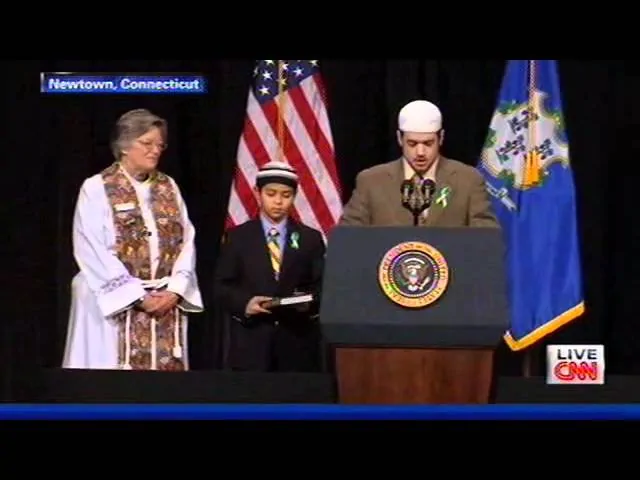
When twenty children and six educators were taken from the world at Sandy Hook Elementary School in Newtown, Connecticut, the grief that followed knew no boundaries of faith, background, or belief. At the national interfaith vigil attended by President Barack Obama, Jason Graves of the Al Hedaya Islamic Center in Newtown stepped forward to speak on behalf of Muslims not only in Connecticut, but across the entire nation. His statement — offered in the name of God, the Compassionate, the Merciful — reflected Islam’s enduring commitment to human dignity, communal solidarity, and the shared search for healing in the darkest of times. It was a moment that demonstrated, quietly and powerfully, that the Muslim community is an inseparable part of the American family.
When Tragedy Dissolves Divisions: A Nation Mourning as One
The statement delivered at the Newtown interfaith service was a testament to the universal values Islam holds at its core — mercy, compassion, and the sacred worth of every human life. Representing American Muslims from across the country, the Al Hedaya Islamic Center joined every faith community in extending prayers for the victims and their families, asking God to grant the innocent souls a place in paradise, and to give their loved ones the strength to endure what no parent, sibling, or child should ever face. The key themes woven through this statement reflect the heart of Islamic spirituality and purpose:
- Shared humanity over sectarian division: In moments of profound grief, artificial barriers between faiths fall away, revealing a nation of mothers and fathers, brothers and sisters united by love and loss.
- Du’a (supplication) as a source of healing: Islam teaches that God is always near and responsive — prayer is not a last resort but the first refuge for a believing heart.
- Interfaith solidarity: The statement called on people of every faith and background to pray together, placing communal healing above theological difference.
- God’s mercy as limitless: The Quran affirms that divine compassion is always accessible, regardless of circumstance or the magnitude of one’s grief.
- Belonging to God: The Islamic declaration Inna lillahi wa inna ilayhi raji’un — “We belong to God and to Him we shall return” — frames loss not as meaningless but as part of a larger, merciful design.
“When my servants question you about Me, tell them that I am near. I answer the prayer of every person who calls on Me.” — Quran, 2:186
Patience, Perseverance, and the Quranic Promise of Ease
Islam’s guidance in the face of tragedy is rooted in the Quran’s timeless teaching on sabr — patient endurance and steadfast trust in God. The statement drew from Surah Al-Baqarah (2:155–157), reminding everyone present that those who respond to calamity by turning to God with humility are the recipients of divine blessings and mercy. This is not passive resignation — it is an active, faith-driven orientation toward the Creator, an acknowledgement that even in unbearable loss, we are held by something greater than our grief. The closing verse invoked at the vigil, repeated twice for emphasis as the Quran itself repeats it, carries a promise that runs through the very core of Islamic spirituality and guidance: hardship is never the final word.
“Give glad tidings to those who endure with patience; who, when afflicted with calamity, say: ‘We belong to God and to Him we shall return.’ Such are the people on whom there are blessings and Mercy from God.” — Quran, 2:155–157
The statement delivered by the Al Hedaya Islamic Center at the Newtown interfaith service stands as a profound example of Islamic values lived publicly — grief shared openly, faith expressed humbly, and solidarity extended without condition. For American Muslims, standing alongside the President and faith leaders of every tradition was not a political act but a deeply human and spiritual one, grounded in the Islamic belief that the loss of a single innocent life is among the gravest of tragedies. Islam’s message to the world in that moment was the same it has always carried: that God’s mercy is without limit, that prayer is a bridge between broken hearts and divine comfort, and that our shared humanity is far stronger than anything that divides us. In remembering Newtown, we are reminded that turning to God — with patience, with trust, and with the certainty that ease follows difficulty — is among the most powerful acts of faith, purpose, and healing any community can offer.