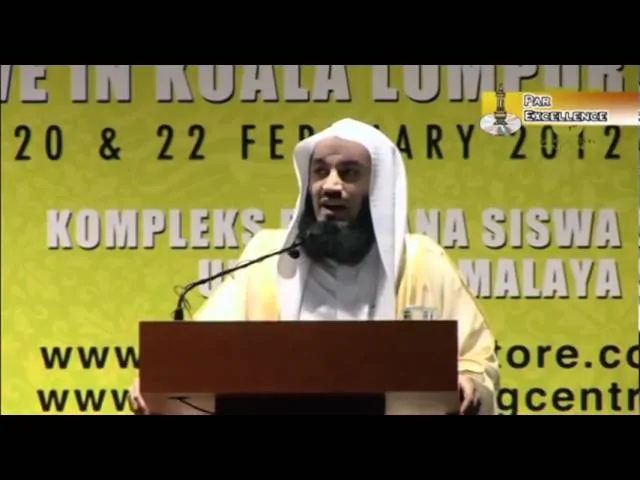
In the sacred institution of the Muslim home, success is not measured by wealth, status, or academic achievement — it is measured by how well parents have nurtured their children in faith, character, and values. In this frank, at times humorous, and deeply moving address, Mufti Ismail Menk — one of the most beloved Islamic scholars of our era — delivers a powerful reminder to parents navigating the pressures of raising Muslim children in today’s complex world. His message, rooted in Quranic guidance and prophetic wisdom, is clear: no matter how righteous the home environment, if parents are not consciously present and actively engaged, the outside world will fill that vacuum — and not always with what Islam teaches.
The External World Is Winning the Battle for Your Child’s Identity
Mufti Menk opens with a sobering observation that strikes at the heart of modern Muslim parenting: the external environment now shapes children more powerfully than anything happening within the home. A daughter who wears hijab at home may remove it the moment she steps onto university grounds. A son raised in a household of salah and adab may adopt an entirely different persona among his peers. This is not simply a failure of upbringing — it reflects that parents have not addressed the critical space between home and the wider world. Islam calls parents to guide their children in choosing righteous companions, to prepare them before they enter new environments, and to have honest conversations about the influences they will encounter. Mufti Menk uses a vivid analogy: a child who was once a big fish in the small, protected pond of home and school is suddenly released into the vast ocean of the world, often without warning or preparation.
“You were a big fish in this little pond. Now you are going to go into the ocean. You are just one of the little fish in that big ocean. Be careful that a whale doesn’t come — or you might be living in the belly of the whale thinking you are in another pool.” — Mufti Ismail Menk
- The external environment — peers, universities, social media — now exerts more influence on children than the home environment alone
- Double lives and hypocrisy in children often stem from a lack of sincere conviction, not bad character — and parents must address this through calm conversation, not condemnation
- Islam emphasises guiding children about the friends they keep and the spaces they enter, before problems arise, not after
- Preparing children spiritually and emotionally for the wider world is a parental obligation that cannot be outsourced to schools or institutions
Presence Is More Valuable Than Provision — The Power of One Shared Meal
With characteristic warmth and gentle humour, Mufti Menk turns his attention to fathers — the busy, distracted, well-meaning men who work tirelessly to provide for their families, yet return home only to sit in front of the television, flicking through channels, while their children sit just metres away hungry not for food but for a father’s attention. The Islamic ideal of fatherhood is not the provider who funds the best schools while remaining emotionally absent — it is the man who sits with his children, looks them in the eye, and asks sincerely, “How was your day?” His advice is beautifully simple: share at least one meal a day with your children. Around that table, more than manners are taught — trust is built, hearts open, and children learn they can bring anything to their parents, including the difficult and troubling. And when they do share something concerning, parents must respond with wisdom and calm engagement rather than anger and ultimatums, because a child whose openness is met with an explosion will simply stop talking altogether.
“One meal with your children a day is worth more than $10,000 — and that is a very minimum figure.” — Mufti Ismail Menk
- Providing financially without emotional presence creates a void that peers and harmful influences will readily fill
- One shared family meal each day is among the most powerful and practical investments a Muslim parent can make
- When a child shares something negative or troubling, engage them in discussion — explosive reactions permanently damage the lines of communication
- A child opening up about a concerning situation is a signal to increase presence and connection, not to panic or withdraw
- A successful businessman whose home is in spiritual and emotional disorder has not truly succeeded — Islam evaluates success through the lens of family, faith, and character
The Muslim family is not a passive structure that maintains itself — it is a living amanah, a sacred trust, that demands daily investment, deliberate communication, and intentional love. Mufti Menk’s guidance is not a checklist of rules but a call to consciousness: every moment of genuine connection with your child is an act of worship, and every moment of distracted absence is a door left open for the world to walk through. Children are watching not what parents say, but what they do — how they treat their spouses, how they respond under pressure, whether they make time for what truly matters. When our children come to us with the hard questions and difficult confessions — and they will — may Allah give us the wisdom to respond as guides rather than gatekeepers, and the humility to recognise that the family we build today is the legacy we leave to this ummah tomorrow.