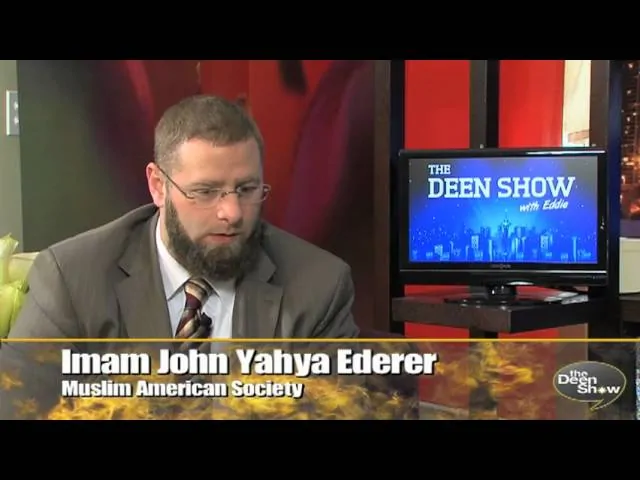
For many people, faith is inherited rather than chosen — passed down through family traditions, cultural expectations, and the quiet assumption that what served one generation will serve the next. But for Imam John Yahya, an American who grew up in a secular Catholic household in Oklahoma, that inherited faith never truly settled the soul. His journey — from nominal Catholicism, through a brief and disillusioning encounter with Born Again Christianity, through years of agnosticism and philosophical searching, and finally to the complete embrace of Islam — is not simply a personal story. It is a living demonstration of the fitrah, the innate God-given nature that draws every sincere human heart toward truth, purpose, and the one Creator who placed that longing there in the first place.
From Cultural Catholicism to the Edge of Honest Doubt
Imam John’s parents both attended Catholic boarding schools but never found the spiritual fulfillment they were seeking, which meant that religion in the family home was largely cultural — Christmas, Easter, and an occasional Mass. At around eleven or twelve years old, a devout Baptist friend introduced him to the idea of being “saved,” and John genuinely attended church, received the special sinner’s prayer, and wanted with all his heart to feel transformed. But when he stole baseball cards from a grocery store just months after claiming to be “one with God and free from the desire to sin,” his mother — working two jobs and raising him largely alone — publicly confronted him in front of the store manager. That humiliating but honest moment shattered the doctrinal logic he had been trying to believe in. If salvation meant no desire to sin, what did it mean that he had just stolen and then lied about it? That question, simple as it was, launched years of genuine theological wrestling. A near-fatal car accident at fifteen deepened his urgency. Long conversations with Father Dan at Bishop Kelly Catholic High School, followed by self-directed studies at community college covering comparative religion, philosophy, and psychology, eventually brought him to a loose Universalist position — he believed in one God but could not bind himself to any tradition, while watching friends around him either end up in prison or lose their lives to violence and reckless living.
- Raised in a culturally Catholic home where religious practice was limited to seasonal observances and offered little genuine spiritual instruction
- Attempted to embrace Born Again Christianity at age eleven but found the doctrine of “no desire to sin after salvation” impossible to reconcile with lived human experience
- Became functionally agnostic after failing to connect with Trinitarian theology, though he never stopped believing in the existence of God
- Survived a near-fatal car accident at fifteen, which sharpened his search for meaning and his relationship with his Creator
- Studied comparative religion, philosophy, and psychology at community college — driven not by academic ambition but by a genuine need to understand what life was for
- Witnessed close friends imprisoned for violent crimes and killed in reckless accidents, forcing a direct confrontation with mortality and purpose
“Nobody will say that their religion is right simply because they were born into it — that does not make it right, that makes it something from your family’s culture. What makes it right is searching, reviewing, researching into the history of that text, into where it came from, what the prophecy is, what the tradition is behind it, what is the miraculous nature of the one it was revealed to. When somebody looks into all of that, searches their heart, and looks into the historical reality of Revelation — those people often embrace Islam.” — Imam John Yahya
The Quran Opens a Door No Human Could Close
The turning point arrived in 1998 at an Olive Garden restaurant in Oklahoma, where a Pakistani Muslim colleague first mentioned Islam to him — and then, in a failure of dawah that Imam John later reflected on with sadness, told him that his American lifestyle meant he could never be Muslim. Undeterred, John visited a local Barnes & Noble, picked up a Quran translation, and was captivated before he had even finished half of Surah Al-Baqarah. He bought it. Within seven to eight days, he had read most of it — skipping forward to find what the Quran said about Jesus, about prophethood, about the nature of God — and found systematic, coherent answers to every theological confusion he had carried since childhood. The Quran did not feel foreign. It felt like the precise articulation of what he had always sensed was true. He walked into a local mosque, embraced Islam, and on that very first day was nicknamed Yahya — the Arabic name for the Prophet John the Baptist, cousin of Jesus (peace be upon them both), a prophet honoured in the Quran and recognised across the Abrahamic tradition. Over the following six months, the structure of the Islamic community helped him disentangle himself from the destructive environment he had known for years, because, as he explained, Islam is not merely a set of beliefs — it is a complete framework for living that aligns the human being with their highest nature.
- Encountered a Muslim colleague who first introduced him to Islam, despite discouraging his interest due to cultural assumptions — a reminder of the responsibility every Muslim carries as a bearer of divine guidance
- Purchased a Quran translation from a local bookstore and was captivated from the very first reading, before even leaving the shop
- Read most of the Quran within seven to eight days, finding clarity on prophethood, the oneness of Allah, and the concept of salvation that no church conversation had ever provided
- Embraced Islam and walked into a mosque for the first time, receiving the name Yahya — Arabic for John the Baptist, a prophet mentioned by name in the Quran
- Understood through the concept of fitrah why he had always felt the pull toward God even during his most wayward years — that pull is built into every human soul by the Creator
- Found that the Islamic community and environment provided the practical conditions needed to rebuild his life on a foundation of faith, morality, and spiritual purpose
“Faith in Islam is a safety net — a comprehensive lifestyle that will remove you from the corruptions and devices of society and help you to build an environment that is beneficial to yourself and others on a spiritual platform.” — Imam John Yahya
Imam John’s story carries a message that extends far beyond one man’s biography. It speaks to the millions raised in inherited traditions who felt, beneath the surface, that something essential was missing — a coherence, a completeness, a faith that could hold up under the honest scrutiny of a searching mind and a troubled life. His path was not a straight line: it wound through disappointment, through near-death, through the loss of friends, and through years of sincere but unsatisfied seeking. Yet each detour was, in retrospect, preparation — stripping away the comfortable assumptions that prevent real inquiry. When he finally opened the Quran, it was not with the passive acceptance of someone who had always belonged to Islam, but with the hard-won clarity of someone who had already ruled out everything else. For any sincere seeker who feels the stirring of the fitrah but cannot yet name what they are looking for, Imam John’s journey is a reminder that the guidance of Allah is real, that the Quran addresses the deepest questions the human heart carries, and that it is never too late — nor ever too unlikely a beginning — to find your way home to Islam.