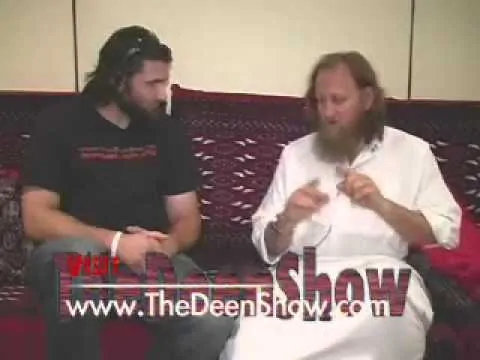
Few conversion stories carry the weight of a life lived across three continents, educated in elite monasteries, and restless enough to invent an entirely new religion from scratch — only to find that the answer had been there all along. Abdur Raheem Green was born Anthony Green in Dar es Salaam, Tanzania, to a British colonial administrator father and a devout Polish Catholic mother. He was sent to a Benedictine monastic boarding school in England, where the religious atmosphere was strong but the answers were thin. From an early age, a single question lodged itself in his mind and refused to leave: if God has no beginning and no end, how can He have a mother? That seed of doubt — rational, sincere, and deeply human — would drive him through Christianity, Buddhism, a self-constructed spiritual philosophy, and ultimately to Islam, the faith he now calls the truth God has ordained for all of humanity.
A Sincere Search Through Christianity and Buddhism
Green describes his Catholic upbringing as rich in ritual but hollow at its theological core. The Hail Mary prayer troubled him as a child — not out of rebellion, but out of honest reasoning. He questioned the Trinity, the need to confess sins to a priest rather than directly to God, and the doctrine of the Incarnation. When a Muslim acquaintance later reduced it to a single question — “You believe Jesus is God, and you believe Jesus died on the cross. So you believe God died?” — Green describes it as the moment the lights came on. He had spent years carrying an unresolved contradiction without realising it had been that simple to name. The materialist philosophy surrounding him offered no better answers: a good degree, a good job, a nice car. To a young man genuinely searching for the purpose of existence, it felt profoundly insufficient. Buddhism offered some relief — meditation, yoga, a framework for inner discipline — but it still failed to answer the foundational questions: why are we here, and what is the purpose of life? More fundamentally, Green disagreed with its core premise. Buddhism teaches that life is suffering caused by the ego, and its answer is to annihilate the self. Islam, by contrast, teaches tazkiyah an-nafs — the purification and disciplining of the self, not its destruction. The passions are not enemies to be erased; they are forces to be controlled and directed toward what is good.
“What is important is the truth — not the consequences of accepting the truth. The truth is something that is virtuous in and of itself.” — Abdur Raheem Green
- Green’s earliest doubts about Christianity were rooted in logic: the concept of God having a mother contradicted God’s infinite, uncreated nature.
- The Trinity, original sin, and vicarious atonement each failed the test of reason — God is self-sufficient and needs no sacrifice to forgive.
- Buddhism’s discipline had a positive effect but left the core questions unanswered, and its doctrine of self-annihilation conflicted with Islam’s teaching of self-purification.
- After constructing his own hybrid religion from Christianity, Buddhism, Hinduism, and philosophy, Green found it to be the worst spiritual experience of all — a dead end that nearly led him to atheism.
- It was a casual desire to understand the Quran — initially sparked by an almost comic line of reasoning about Saudi wealth — that led him to read it seriously, and it was the Quran that finally convinced him.
The Quran, Divine Unity, and the Purpose of Life
Green’s path to the Quran was, by his own admission, unexpected. After his self-made spiritual experiment collapsed, he found himself wondering whether the purpose of life was simply wealth — and which people had acquired the most with the least effort. The thought led him, somewhat humorously, to the Arabs, which led him to Islam, which led him to walk into a bookshop and pick up a translation of the Quran. What followed was a sustained, serious engagement with a text he describes as unlike any other — not a linear narrative, not a simple moral code, but something that spoke directly and unmistakably. After reading and rereading, the conviction settled: of all the books he had encountered, of all the religions he had examined, this was the one that carried the mark of divine origin. The Islamic concept of tawhid — the absolute oneness of God — answered every theological problem that had followed him since childhood. God is transcendent, eternal, self-sufficient. He does not become finite, does not die, does not need an intermediary. Forgiveness is not transactional; it requires only sincere repentance, a genuine turning back to the One God, and a commitment not to repeat the sin. God’s mercy, Green explains, is so vast that He will not merely forgive — He will replace evil deeds with good ones for the one who truly returns to Him. As for those who say they believe in God but reject organised religion, preferring to pick and choose: Green offers the analogy of a sick man who, after a bad experience with one dishonest doctor, abandons medicine entirely in favour of a personal mixture of witchcraft and folk remedies. The problem was never medicine — the problem was a bad doctor. God has given human beings reason precisely so they can investigate, verify, and choose wisely.
“True freedom comes from submitting oneself to God — not by submitting yourself to your desires. The one who does what they like is not free; they are a slave to their passions.” — Abdur Raheem Green
The story of Abdur Raheem Green is, at its core, a story about intellectual honesty in the face of social pressure, cultural conditioning, and the comfortable temptation to stop asking hard questions. He was raised with privilege and educated in an institution that demanded religious conformity — yet the fitrah, the innate God-given nature in every human being, kept pushing questions to the surface that no one around him could adequately answer. Islam did not give him something new to believe; it confirmed what reason, justice, and the consistent message of all the prophets had always pointed toward: that God is One, that He alone is worthy of worship, that human beings are not left without guidance, and that the Quran is that guidance preserved and alive. For anyone on their own search — whatever background, whatever baggage, whatever combination of beliefs has accumulated over a lifetime — his journey is a reminder that sincerity is the starting point, and that the question worth asking is not “what will people think?” but simply: is this the truth?