Across the Western world, a growing number of intelligent, inquisitive people are walking away from religion — not out of moral indifference, but because they perceive an irreconcilable conflict between faith and reason. They have encountered scientific errors in religious texts, watched institutions suppress inquiry during the Renaissance and Industrial Revolution, and concluded that belief requires surrendering the intellect. Islam offers a direct and sincere answer to that challenge. Far from demanding blind faith, Islam — submission to the one Creator — grounds itself in verifiable facts, preserved revelation, and a centuries-long legacy of scientific leadership. The Quran, revealed to the Prophet Muhammad ﷺ in 7th-century Arabia, contains descriptions of cosmology, embryology, pain receptors, and the origin of life that modern science confirmed over a thousand years later. For the sincere truth-seeker willing to set aside prejudice, the evidence is not a matter of lullaby stories — it is a matter of documented, peer-reviewed fact.
The Quran’s Scientific Precision: From the Big Bang to Human Embryology
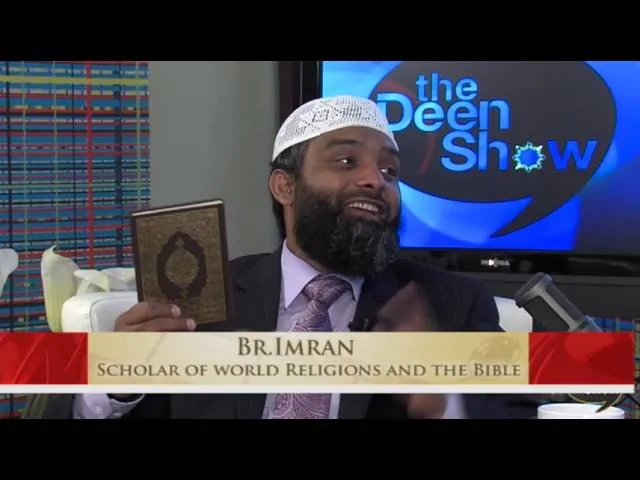
The guest on this episode of The Deen Show, Brother Imran — president of the Islamic Research and Educational Foundation in Hyderabad, India and a noted scholar of comparative religion — walked through some of the most striking Quranic scientific facts, contrasting them with the well-documented contradictions found in Genesis (chapter one, verses 1–30), where vegetation is said to grow before the sun is created, and where the moon is described as a self-luminous body. These errors led educated Western Christians to question whether their scripture could truly be divine in origin. The Quran, by contrast, has never been altered since its first revelation — original manuscripts preserved in Istanbul and the British India Museum match every copy in the world today, letter for letter, without a single full-stop difference. Even more remarkably, Arabic — unlike every other language on Earth — has remained phonetically and linguistically consistent for 1,430 years specifically because the Quran anchored it. These are not rhetorical claims; they are historical facts. And they serve as the foundation for evaluating what the Quran says about the natural world.
“The Quran has so many things which are scientific, spoken at a time when there was no way of speaking those subjects — no chance of a human being talking about those things which we, as the modern world, only discovered a few years back.” — Brother Imran, Islamic Research and Educational Foundation
- The Big Bang (Surah 21:30): The Quran describes the heavens and the earth as having been “joined together as one unit of creation” before being cleft asunder — a description that maps precisely onto the nebular singularity model first formally proposed in the early 1970s, over 1,400 years after the Quranic revelation.
- Water as the Origin of Life (Surah 21:30): The same verse states “We made every living thing from water.” Modern science confirmed in the 1990s that DNA — the basic unit of life — depends on water molecules (H₂O hydrogen ions) for its own survival, a fact that had no discoverable parallel in 7th-century Arabia, a land where water was scarce enough that companions of the Prophet ﷺ traveled miles for a single drop.
- Human Embryology (Surah 23:12–14 and Surah 96:2): Dr. Keith Moore, former dean of embryology at the University of Toronto and author of the standard medical syllabus on human development, examined the Quranic term alaq (used to describe the early embryo) and found it carried three meanings — something resembling a leech, something that clings, and something that sucks — all three of which are scientifically accurate descriptions of the embryo at that developmental stage. He stated publicly: “I have no doubt to accept that this Quran is not a human production. It is impossible for any human being to know about this.”
- Pain Receptors in the Skin (Surah 4:56): A medical scientist from the University of Bangkok presented research showing that pain sensation comes not from the nervous system alone but from sensory cells beneath the skin. A Muslim doctor pointed out that Surah 4:56 — describing the replacement of burned skin in the Hellfire so that disbelievers keep feeling pain — implies this precise mechanism. The researcher declared his shahada (testimony of faith) at the conference.
- Unique Fingerprints (Surah 75:3–4): The Quran references the fingertip as a site of unique individual identity. Western science formally recognised the uniqueness of fingerprints only in 1790 — over eleven centuries after this Quranic verse.
- One sixth of the Quran deals with natural science: Of approximately 1,000 ayat addressing medicine and the natural world, 750 to 780 have already been confirmed correct by modern science. The remaining 220 or so are not contradicted — science simply does not yet have the instruments to verify them.
What This Means for the Honest Seeker — and the Sincere Atheist
“The Quran is the scale to judge science. We do not take science as the scale to judge the Quran.” — Brother Imran
The atheist, as Brother Imran observed with care rather than contempt, is often sincerely trying to apply reason and reject falsehood. In that, he has already accepted the first half of the Islamic creed — laa ilaaha, there is no god among the false gods presented to him. What remains is only one step further: recognising that beyond all those false objects of worship — idols, desires, money, status — there is one true Creator, Allah, who alone deserves submission. The Prophet Muhammad ﷺ was born in the desert of Makkah in 570 CE, grew to the age of forty without ever learning to read or write (confirmed in Surah 62:5 and Surah 29), and lived among a people whom historians like Thomas Carlyle described as considered entirely marginalised by the great empires of the time. That an unlettered man in such a setting produced a book that Einstein-calibre scientists, embryologists, and surgeons have marvelled at is not a coincidence — it is the most intellectually honest explanation available. French surgeon Dr. Maurice Bucaille, after writing The Bible, the Quran and Science and cataloguing the scientific errors in the Bible alongside the verified accuracy of the Quran, became Muslim. His journey is the journey Islam invites every honest person to take: read with an open mind, weigh the evidence with sincerity, and follow the guidance where it leads. Islam is not a demand to park your intellect at the door — it is the only path that asks you to bring your full, God-given intelligence with you.