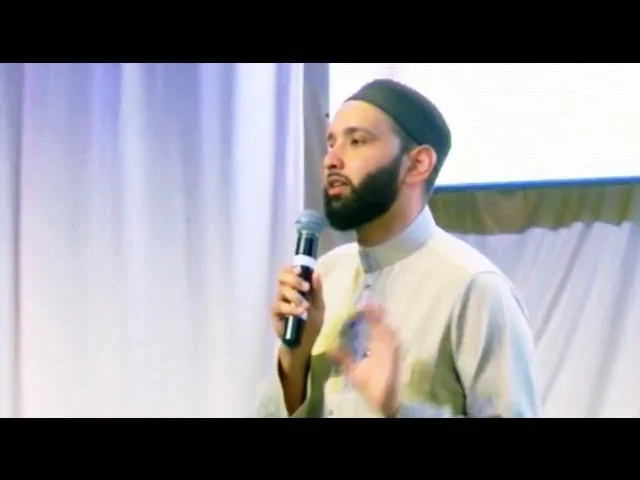
What truly constitutes a successful life? Sheikh Omar Suleiman, addressing a packed hall at the Twins of Faith conference, posed a question that cuts through the noise of modern existence: we spend our days accumulating, achieving, and performing — yet many of us carry a quiet, persistent emptiness. Drawing on Surah Al-‘Asr, the prophetic traditions, and a framework for human flourishing that secular thinkers are only now beginning to articulate, Sheikh Omar lays out a precise, actionable map to the goal of life in Islam — not a vague spiritual aspiration, but a clear destination with defined waypoints along the road of faith and purpose.
Three Foundations of a Fulfilling Life — and the Quran’s Timeless Answer
Philosopher Joseph Addison observed that three things are necessary to live a truly happy life: something to do, something to love, and something to look forward to. Remove any one of these and the structure collapses — the retiree who loses purpose, the high achiever whose family falls apart, the celebrity who has fame and wealth yet nothing worth living for. What is remarkable, Sheikh Omar points out, is that Allah subḥānahu wa-taʿālā encoded this exact formula into the Quran centuries before Addison: “Rush towards the forgiveness of your Lord” (something to do), “and a paradise as vast as the heavens and the earth” (something to look forward to), and — above all of it — the love and consciousness of Allah Himself (something to love). The world’s self-help industry is painstakingly reconstructing what divine revelation already delivered.
“By Al-‘Asr (the time) — Verily! Man is in loss, except those who believe and do righteous good deeds, and recommend one another to the truth, and recommend one another to patience.”
— Quran, Surah Al-‘Asr (103)
Taqwa, Ihsan, and the Qualities That Define True Excellence
Before excellence (ihsan) can be reached, its prerequisite must be established: taqwa — God-consciousness that navigates a path through life’s thorns, pulling back whenever a sin pricks the soul rather than pressing forward and letting it tear deeper. Once that foundation is in place, the Quran defines the muhsin — the person of spiritual excellence — with qualities that all share the same structure: going far beyond what society expects, and measuring yourself only against what Allah expects.
- Give in both hardship and ease. No one expects the struggling person to donate. Society reserves those expectations for the wealthy. But the Prophet ﷺ taught that one dirham given by a man who had only two exceeded 100,000 dirhams in reward — because what matters in Allah’s sight is the sacrifice, not the sum.
- Swallow your anger. When someone insults you, every social norm gives you the right — even the obligation — to respond. The muhsin holds to a higher standard: he swallows it, not out of weakness, but because he wants Allah — who has every right to be angry with us — to withhold His anger on the Day of Judgement.
- Pardon those who wrong you. Abu Bakr as-Siddiq RA, upon learning that a relative he had supported for years had spread slander against his own daughter Aisha RA, said only: “I will not give him charity anymore.” When Allah then revealed the verse urging pardon — “Do you not love that Allah should forgive you?” — Abu Bakr immediately resumed his charity. This is the measure of ihsan: forgiving not because society expects it, but because Allah’s forgiveness of us is inseparable from how we forgive others.
- Turn to Allah immediately after sin. The muhsin does not spiral into shame about his reputation or career — he turns directly to his Creator in repentance, knowing that no one forgives sins except Him, and resolving not to return knowingly while Allah watches.
- Ignore the status quo and raise your personal standard. Doing just enough to satisfy society’s expectations — giving just enough charity, attending the masjid just enough — is the spiritual danger of living for an audience rather than for Allah. True guidance demands more than performance; it demands sincerity.
The Highest Goal: Seeking Only the Pleasure of Allah
“Worship Allah as if you see Him; and if you cannot see Him, know that He sees you.”
— The Prophet Muhammad ﷺ, defining Ihsan (Hadith Jibril, Sahih Muslim)
The pinnacle of all this — the “more” that Allah promises to those who excel, beyond even the boundless expanse of Jannah — is the sight of Allah’s Face. Every act of giving in hardship, every swallowed anger, every pardoned wrong, every tear in a pre-dawn prayer that no one else witnessed: it was all building toward that one encounter. Sheikh Omar closes with a challenge drawn from Maslow’s hierarchy of needs, whose summit — self-actualisation — is defined as becoming independent of the opinions of others. Islam arrived at this destination long ago. The believer anchored entirely to the pleasure of Allah subḥānahu wa-taʿālā — who, like the great scholars of our tradition, would refuse to disobey Allah even if there were no heaven or hell, purely out of love — has already achieved what the world’s psychology is still trying to name. Raise your standard. Not for your community’s approval, not to perform piety for an audience, but because the love of Allah is the one thing that makes everything else — wealth, reputation, even the dunya itself — inconsequential by comparison, and because the only opinion that will matter when you stand before your Lord is the one you have been shaping, through every small act of sincerity and sacrifice, for the entirety of your life.