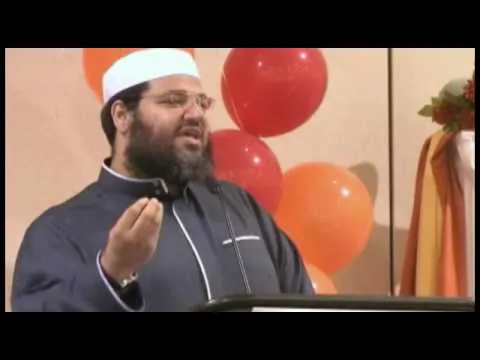
There is an image Shaykh Waleed Basyouni describes that is impossible to unsee: a young man, clearly religious, full of energy and commitment, his outward appearance radiating devotion to faith — and then, moments later, the same young man reduced to fragments on the pavement, having taken innocent lives in what he believed was an act of worship. This lecture, delivered at AlMaghrib Institute’s IlmFest 2009, confronts one of the most painful realities facing the Muslim ummah today — not from a place of defensiveness or political point-scoring, but from a place of genuine love: love for young Muslims being deceived into paths of destruction, love for the authentic tradition of Islam, and love for the truth that guidance demands we speak even when it is difficult.
Good Intentions Are Not Enough — The Tragedy of Misguided Zeal
Shaykh Waleed draws a devastating portrait of how vulnerable young Muslims are recruited into extremism. These are not people without faith — many are deeply motivated by sincere love for Islam and genuine anguish over the political suffering of Muslims worldwide. But sincerity of intention, in Islamic scholarship, has never been sufficient justification for a forbidden act. Their leaders quote Quranic verses and hadith selectively, exploiting religious knowledge gaps to send young men and women into suicide missions — while watching safely from a distance. The consequences ripple outward: shattered families, communities under backlash, lifetimes wasted behind bars or lost entirely. The scholar’s statement that resonated deeply with the Shaykh comes from early Islamic history, when a group approached a wise worshipper inviting him to join a rebellion against an unjust ruler:
“I have only one soul, one life, one chance. If I die, I will never be sent back to this worldly life to correct what I have done wrong. So I would rather on the Day of Judgment be asked ‘why did you not participate?’ than to be asked ‘why did you kill someone.'”
This is the voice of Islamic wisdom under pressure — caution rooted not in cowardice but in a profound awareness of the weight of human life in the sight of Allah. Shaykh Waleed reinforces this with the Quranic warning about those who perform deeds in this world while losing everything in the Hereafter — people who believed they were doing good, yet whose actions were fundamentally wrong. The key takeaways from this section of his lecture include:
- Good intention alone does not sanctify a forbidden action — Islamic jurisprudence has always required both correct intention and correct method.
- Extremist recruiters deliberately target Muslims with limited religious education, selectively citing Quran and hadith to manufacture false justifications for violence.
- The greatest crimes in Islam — after shirk — include the unjust taking of human life, which these acts represent in their most severe form.
- Leaders who send others to die while remaining safe behind the scenes are not engaged in jihad of any kind — they are exploiting the faith of others for political ends.
- Silence in the face of growing extremism is itself a form of negligence — scholars who once hoped to “let the pressure build” against governments came to deeply regret not speaking sooner.
The Islamic Tradition Has Always Confronted and Contained Extremism
One of the most reassuring and grounding aspects of Shaykh Waleed’s lecture is his reminder that this is not a new crisis for the Muslim ummah. The Khawarij — the first violent splinter group in Islamic history — emerged during the time of the companions themselves, and the Prophet ﷺ warned explicitly that such groups would continue to appear until the end of times. What history also demonstrates, however, is that the mainstream Muslim community has always identified, rejected, and isolated these deviant currents. Extremist groups, Shaykh Waleed observes with striking clarity, are never truly embedded in the living Muslim community: you will not find them organising blood drives, serving the homeless, or actively building their local masjid. They inhabit online forums and isolated networks precisely because authentic Islamic community life — with its emphasis on service, scholarship, and brotherhood — has no room for their ideology. The word jihad itself has been wrongfully appropriated; in Islamic tradition it is a term of spiritual beauty and noble sacrifice, not a label for transgression and murder. Classical scholars never dignified deviant sects with the honorific names those groups chose for themselves — and mainstream Muslim scholarship today holds the same position. The Prophet ﷺ foretold this group in the clearest terms:
“Their prayer and fasting will make even the companions’ worship seem small in comparison — yet the Quran they recite will not travel past their throats. They exit Islam as an arrow exits its target, and they will never return to it.”
What Shaykh Waleed ultimately calls the Muslim community to is not defensiveness, not denial, and not a false choice between condemning extremism and acknowledging the real injustices faced by Muslims around the world. One wrong does not cancel another — both can and must be named. The antidote he returns to, again and again, is the same one AlMaghrib Institute was founded upon: education. An ummah rooted in authentic Islamic knowledge — that understands the principles and foundations of the deen, that studies history, that engages with real scholarship — is naturally inoculated against the distortions extremists exploit. Faith grounded in genuine understanding of the Quran and Sunnah does not produce violence; it produces the very opposite. The spirituality and purpose Islam offers are too rich, too complete, and too deeply human to be reduced to what these fringe groups represent. The call in this lecture is ultimately a call to reclaim that richness — through knowledge, through community, and through the courage to speak the truth with wisdom and compassion.