
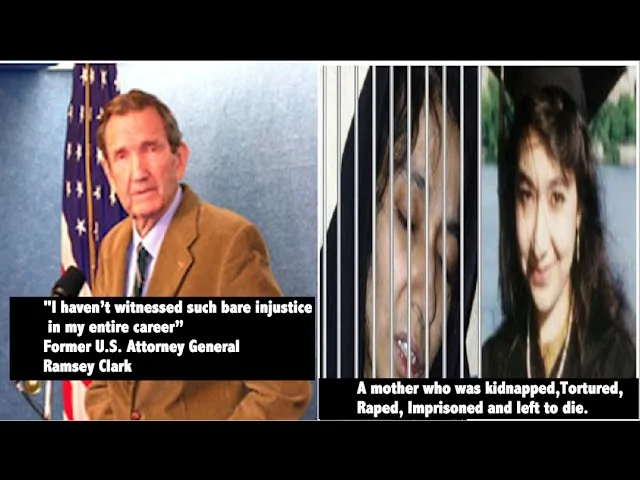
When former U.S. Attorney General Ramsey Clark — the highest law enforcement officer in American history — states publicly that he has never witnessed such “bare injustice” in his entire career, the world is obligated to listen. The case of Dr. Aafia Siddiqui, a Pakistani-American neuroscientist, MIT-educated academic, Hafiza of Quran, and dedicated humanitarian, has united an extraordinary coalition of voices — Christian pastors, former senators, peace activists, and legal giants — all calling for the same thing: justice. This episode of The Deen Show cuts through the noise, the media smears, and the political manipulation to present the documented facts of one of the most controversial and deeply troubling cases in modern American legal history, raising urgent questions that touch the very foundations of Islam’s call to truth, justice, and the sanctity of every human life.
A Cross-Faith Coalition Speaks: When Conscience Transcends Religion
- Former U.S. Attorney General Ramsey Clark, at 85 years old, traveled to Pakistan and Fort Worth, Texas to personally advocate for Dr. Aafia’s release, calling hers “the worst case of individual injustice” he has witnessed in his entire career.
- Former U.S. Presidential candidate and two-time Senator Mike Gravel publicly declared Dr. Aafia’s imprisonment “a great injustice,” traveling to Pakistan to urge officials to demand her repatriation.
- Former Congresswoman Cynthia McKinney (Georgia) spoke out and traveled to Pakistan in solidarity with the cause.
- Reverend Kathleen Day, an American Christian pastor, added her voice in defense of Dr. Aafia — demonstrating that concern for justice in this case crosses religious and political lines.
- Anti-war activist Cindy Sheehan described Dr. Aafia as “a political prisoner and the political bogeyman for two U.S. regimes” — a victim of rendition, torture, and a sham trial.
- Despite being labelled “the most dangerous woman in the world” by then-Attorney General John Ashcroft in 2004, Dr. Aafia was never charged with a single terrorism offense.
- A non-Muslim college student, Christopher Town, was so moved by her story that he produced a comic book documenting her case — illustrating how concern for her plight has spread far beyond Muslim communities.
“Dr. Aafia Siddiqui was victimized by the international politics being played for power. I haven’t witnessed such bare injustice in my entire career. Neither did Dr. Aafia kill anyone, nor did she attempt it — in fact she was shot, and she should be released immediately.” — Former U.S. Attorney General Ramsey Clark
The Prophet Muhammad ﷺ taught that when one witnesses an evil action, they must change it — with their hand, their tongue, or at the very least with their heart — and that this obligation carries no condition of religion or nationality. This is precisely the spirit that unites the advocates in Dr. Aafia’s case. At trial, soldiers’ testimonies contradicted each other and conflicted with their own prior statements. There was no forensic evidence linking her to the alleged shooting — video footage in the U.S. government’s possession for months showed the same bullet holes in the police station walls the day before Dr. Aafia arrived. The jury, left unsequestered, was free to absorb a media environment saturated with post-9/11 fear and deliberate smears portraying her as an al-Qaeda courier, a blood diamond runner, a bomb-maker. As a respected British journalist who attended the entire trial observed, the case against Dr. Aafia was built on “a bodyguard of lies” — a false image manufactured to convict in the court of public opinion long before any verdict was delivered in a court of law. The result was an 86-year sentence for a woman who, by her own government’s admission through its own charging decisions, had not committed a single act of terrorism.
A Daughter of the Ummah: Who Dr. Aafia Siddiqui Truly Was
Dr. Aafia Siddiqui came to the United States from Pakistan at age 18, graduated with honours from MIT, and earned her doctorate from Brandeis University — where she studied how to improve educational systems for disabled children, volunteering directly with those students to apply her research. She was a passionate leader in her Muslim Student Association, pleading tearfully for Bosnian refugees and carrying heavy boxes of donations for prisoners even while pregnant. She was a Hafiza of Quran, one who had memorised the entire Book of Allah. In March 2003, she vanished with her three young children en route to Karachi Airport. Five years later she reappeared in Afghanistan, shot multiple times and barely alive. Multiple witnesses and a secretly recorded tape of a Pakistani police superintendent place her in secret detention at Bagram — where fellow prisoners, sickened by the screams of a woman being tortured, staged a hunger strike in her defence, calling her “the Grey Lady of Bagram.” Her youngest child, Suleiman, has never been found. Her trial was conducted without the right to choose her own legal team, before an unsequestered jury, and with the spectre of terrorism invoked relentlessly despite no terrorism charge ever being filed. Even her chemistry coursework at MIT was weaponised to paint her as a bomb-maker. Five years of secret imprisonment were ruled “irrelevant” to her trial. She was sentenced to 86 years in federal prison.
“My fate lies with Allah and my destiny is with my Lord. The decision of my fate is my God’s — not yours.” — Dr. Aafia Siddiqui, addressing the court at her sentencing
These words — spoken with unshakeable iman and extraordinary grace by a woman who had endured years of alleged torture and the loss of her children — reveal a spiritual strength that no injustice can extinguish. The great scholar Ibn Taymiyyah (rahimahullah) wrote that civilization rests upon justice and that Allah aids the just state even if non-Muslim, yet withholds His support from the oppressive state even if it claims Islam. Thomas Jefferson himself trembled at the thought of divine justice falling upon a nation that forgets it. As the advocates in this episode remind us: if what was done to Dr. Aafia — a distinguished scholar, a devoted mother, a woman of faith and purpose — can go unchallenged, then no one is safe. The guidance of Islam is clear: stand for truth without violence, repel evil with what is better, and let the pursuit of justice be the measure of a community’s spiritual health. Raising awareness of this case — sharing it, speaking about it, demanding accountability — is itself an act of faith, a living expression of the conviction that divine justice, as both traditions affirm, cannot sleep forever.