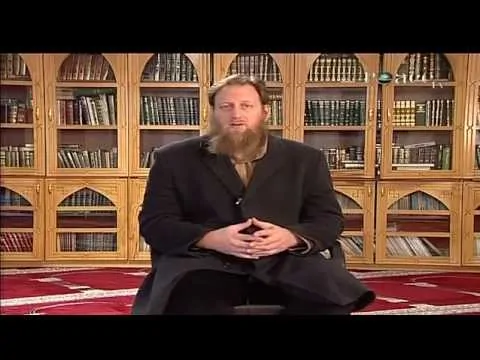
Few religions in modern times have been as persistently misrepresented as Islam — yet few carry a message as universal, rational, and spiritually profound. In this landmark talk by Abdur Raheem Green — a British-born scholar who embraced Islam in 1987 after years of searching through philosophy, spirituality, and scripture — the most foundational questions about the faith are addressed with clarity and conviction: Who is Allah? Is He the same God worshipped by Jews and Christians? And what does Islam truly teach about the nature of the Creator? These are not abstract theological puzzles. They are questions that strike at the heart of human purpose, faith, and our relationship with the divine, and they deserve honest, careful answers.
Allah — One Name, One God, Shared Across All Traditions
One of the most persistent misconceptions about Islam is that “Allah” refers to a separate, foreign deity — distinct from the God of the Bible or Torah. Abdur Raheem Green dismantles this misunderstanding through both linguistics and theology. The word Allah is derived from the Arabic Al (the definitive article) combined with ilah (a deity or object of worship) — literally meaning “The God,” the singular, supreme Being who alone deserves worship. This is not a new coinage: Arabic-speaking Christians and Jews have always referred to God as Allah, and the Arabic Bible itself uses the name throughout. The linguistic connection runs deeper still — the Hebrew words for God (El, Eloah, Elohim) and the Aramaic word used by Jesus (Alaha) bear a striking similarity to the Arabic Allah, a natural consequence of their shared Semitic roots. Even the pagan Arabs of pre-Islamic Arabia, who worshipped 360 idols around the Ka’bah, nonetheless acknowledged Allah as the supreme Lord of the heavens, the Sender of rain, the Giver of life and death. The Quran captures this directly, recording how when the Prophet Muhammad ﷺ asked the idol-worshippers who controls the heavens and the earth, their answer was always: Allah. The concept of God in Islam is therefore not a new invention — it is the original, uncorrupted understanding of the one Creator that runs through all of the Abrahamic faiths and, in various forms, resonates across the spiritual traditions of humanity.
- The word Allah simply means “The God” in Arabic — not a foreign or exclusive name for a different deity
- Arabic-speaking Christians and Jews use Allah to refer to God; the Arabic Bible does the same
- Hebrew and Aramaic equivalents — El, Elohim, Alaha — closely mirror the Arabic Allah, reflecting shared Semitic origins
- Even pre-Islamic pagan Arabs acknowledged Allah as the ultimate Creator, Sustainer, and Lord of the heavens
- Islam, Judaism, and Christianity share the same fundamental concept of a transcendent, all-knowing, self-sufficient Creator
- The Quran’s purpose is not to introduce a new God, but to restore the pure and original understanding of the one God
“Say: He is Allah, the One — the One upon whom all things depend. He does not beget, nor was He begotten. And there is nothing that can be likened unto Him.” — Surah Al-Ikhlas (112:1–4), as explained by Abdur Raheem Green
A Greatness Beyond Imagination — The True Majesty of the Creator
Islam does not merely assert that God exists — it invites the believer to genuinely reflect on His immeasurable greatness. Abdur Raheem Green draws on a profound hadith of the Prophet Muhammad ﷺ to illustrate this: the entire universe — spanning some 10 billion light years in every direction — is like a ring thrown into a vast desert when compared to the Kursi, the footstool of Allah. And the Kursi itself is like that same ring thrown into a desert when compared to the Arsh, the Throne of Allah. Our universe, in all its incomprehensible scale, is an infinitesimally small speck before the majesty of the Creator. From this flows a critical principle in Islamic spirituality: to imagine Allah as resembling anything in creation is not merely a theological error — it is a profound insult to His transcendent nature. Surah Al-Ikhlas declares with absolute clarity that nothing can be likened unto Him. This doctrine of divine uniqueness — tanzih — protects the purity of faith from every form of idolatry, whether physical or conceptual. And while Allah’s mercy is vast enough to forgive any sin He wills, the Quran is unambiguous that shirk — ascribing partners, rivals, or equals to Him — is the one transgression that will not be forgiven if a person dies upon it. The gravity of this teaching is underscored by a deeply moving hadith in which Allah addresses a person on the Day of Judgement who would have willingly surrendered the entire world twice over to escape the Fire.
“I asked you for less than that. I only asked you that you should worship Me, and worship only Me.” — Allah’s words to a person on the Day of Judgement, as narrated in a hadith of the Prophet Muhammad ﷺ
What makes Islam’s understanding of God so enduring — and so urgently needed in a world saturated with noise and misdirection — is that it speaks directly to what is already written within the human soul. In Arabic, this innate recognition of the Creator is called fitrah: the natural disposition embedded within every human being at birth. No matter how far a person may drift from faith, in the moments of deepest fear and greatest vulnerability, even the most committed skeptic finds themselves reaching instinctively toward the one God. This is not sentiment — it is, as Islam teaches, the echo of our truest nature. The message that Abdur Raheem Green conveys in this talk is ultimately an invitation: to look past the media distortions, the cultural misrepresentations, and the accumulated misunderstandings, and to encounter Islam’s central teaching of tawhid — the absolute Oneness of God — on its own terms. The God of the Quran is the God of Abraham, Moses, and Jesus, peace be upon them all. He is the Creator who sustains every atom of the universe, who hears all, knows all, and guides all things toward what is best for them. To recognise this truth with the heart, and to respond to it with sincere worship, is precisely what Islam means — and it is a guidance available to every human soul willing to reflect.